India’s Upper House and Its Unique Selection Process
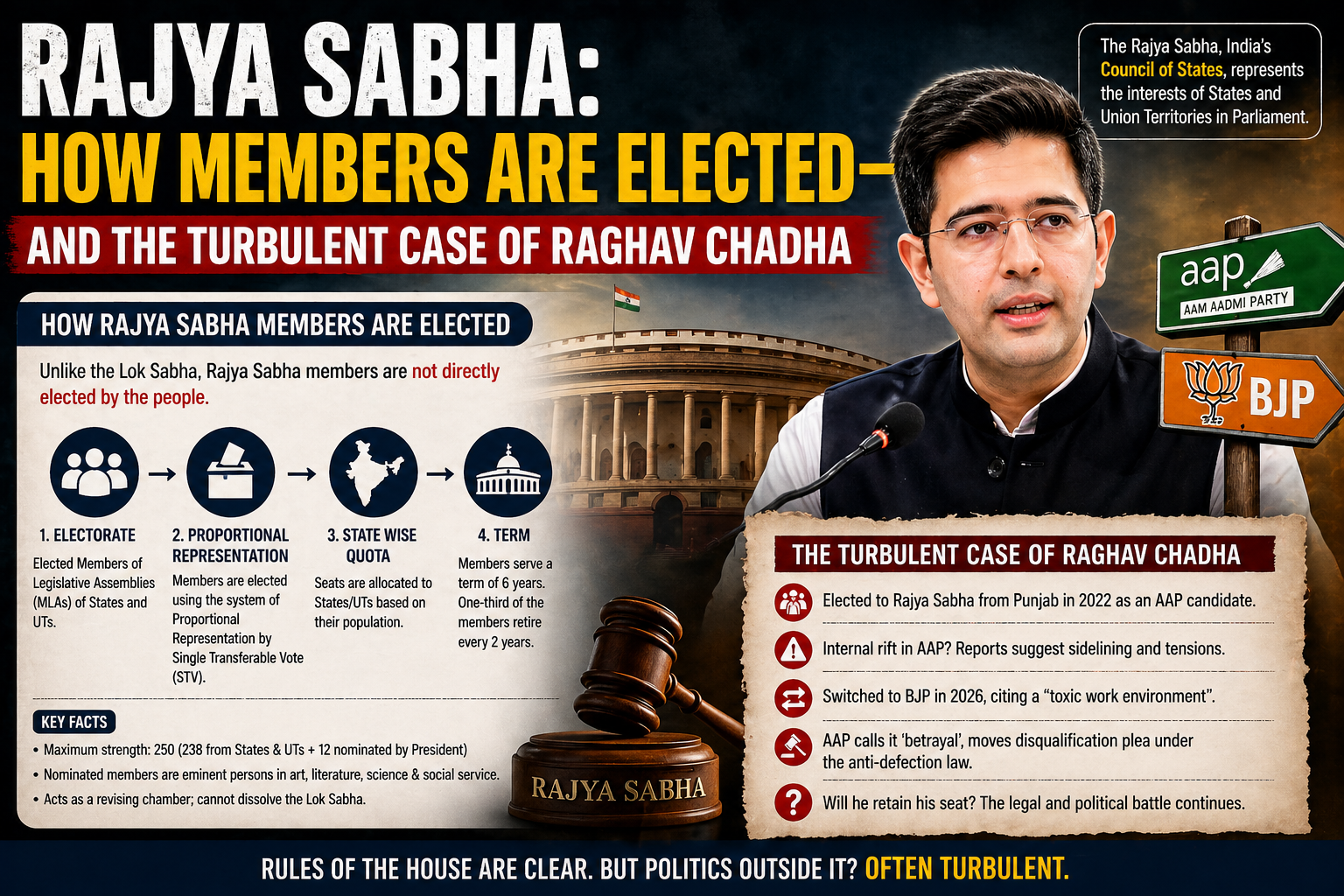
The Rajya Sabha, officially known as the Council of States, is the upper house of India’s bicameral Parliament. Unlike the Lok Sabha, whose members are directly elected by the people, the Rajya Sabha follows a system of indirect election — making its composition a fascinating reflection of state-level political arithmetic.
The Rajya Sabha has a maximum membership of 245, of which 233 are elected by the state legislative assemblies and union territories using single transferable votes through open ballots, while the President of India can appoint 12 members for their contributions to art, literature, science, and social service.
Crucially, unlike the Lok Sabha, the Rajya Sabha is a continuing chamber and is not subject to dissolution. Members serve staggered six-year terms, with about a third of the 233 members up for election every two years, in even-numbered years.
How Are Rajya Sabha Members Elected?
Who Votes?
While Lok Sabha members are elected directly by the voters, Rajya Sabha members are elected indirectly — by the elected Members of a state’s Legislative Assembly (MLAs). How many Rajya Sabha members a state can send depends on its population.
The representatives of each state and union territory are elected by the elected members of the Legislative Assembly of that state, by the system of proportional representation using the single transferable vote.
Qualifications for Membership
A member of the Rajya Sabha must be a citizen of India, be at least 30 years old, not hold any other office of profit under the Government of India, and not be of unsound mind.
The Voting Formula
In order to win, a candidate needs a specific number of first-preference votes. The formula is: Required votes = [Total number of votes / (Number of Rajya Sabha seats + 1)] + 1. This ensures that even opposition parties in a state assembly can secure representation if they have sufficient numbers.
The Open Ballot System
The foundation of free and fair elections is typically the secrecy of the ballot, but Rajya Sabha elections are unique in that voting is not secret. The MLAs elect their state Rajya Sabha MPs and, as the process stands now, have to show the votes to their party’s representative.
Rajya Sabha elections were conducted by secret ballot before 2003, but an amendment to the Representation of the People Act in 2003 introduced the open voting system to help prevent cross-voting.
The Supreme Court, when this system was challenged, reasoned that “if secrecy becomes a source for corruption, then sunlight and transparency have the capacity to remove it.”
Presidential Nominations
Beyond elected members, twelve members are nominated by the President of India who have special knowledge in various areas like arts and science. However, they are not entitled to vote in presidential elections. This provision allows for the inclusion of distinguished citizens who might not otherwise enter electoral politics.
The Raghav Chadha Saga: Suspension and Political Transformation
Few recent cases illustrate the turbulence that can accompany Rajya Sabha membership better than that of Raghav Chadha — a politician whose journey from being one of the youngest Rajya Sabha members to his suspension, reinstatement, and ultimately a party switch, has been nothing short of dramatic.
Rise to the Upper House
On 21 March 2022, AAP announced the nomination of Chadha and four other individuals as the Rajya Sabha members from Punjab for a six-year term. This made him the youngest Indian Rajya Sabha MP ever at the age of 33. He was also appointed as a member of Parliament’s Standing Committee on Finance.
The Controversy That Led to Suspension
On 8 August 2023, five MPs claimed that their names were mentioned on the proposal to send the Delhi NCR Amendment Bill to a Select Committee without their consent, by a motion moved by Raghav Chadha. They accused Chadha of forgery and breach of privilege.
AAP MP Raghav Chadha was subsequently suspended from Rajya Sabha for “gross violation of rule, misconduct, defiant attitude and contemptuous conduct,” pending a report by the privileges committee.
His suspension followed a motion moved by Leader of the House Piyush Goyal, who sought action against the AAP leader for including names of some members of the Upper House in a proposed select committee without their consent. The motion was passed by a voice vote.
Opposition Outrage
The suspension drew fierce criticism from across the aisle. Congress deputy leader Pramod Tiwari called it wrong to suspend members in this manner, while Priyanka Chaturvedi of Shiv Sena called it “absolutely unfortunate” that the government was suspending opposition members for raising questions. Mahua Maji of Jharkhand Mukti Morcha described Chadha as a very active member of the opposition.
Reinstatement After 115 Days
Chadha did not accept the suspension quietly. He approached the Supreme Court for relief. The Supreme Court took cognizance of the matter and his suspension was revoked after 115 days.
Party Switch and New Chapter
The story didn’t end there. In 2026, Chadha’s political allegiances dramatically shifted. On 2 April 2026, AAP suddenly removed Chadha from the post of its deputy leader in the Rajya Sabha, replacing him with Punjab MP Ashok Kumar Mittal, a move said to be the result of Chadha’s prolonged absence from key party events.
Amid speculations, Chadha defected to the Bharatiya Janata Party on 24 April 2026, along with 6 other AAP MPs of the Rajya Sabha — despite having previously referred to the BJP as a party of “illiterate goons.”
What Chadha’s Case Reveals About Rajya Sabha Politics
The Raghav Chadha episode offers a window into the high-stakes, often combative nature of Indian upper house politics. The Rajya Sabha, designed as a deliberative chamber of sober second thought, has increasingly become an arena for political confrontations — between ruling and opposition parties, and sometimes within parties themselves. The suspension mechanism, while rooted in the need for parliamentary discipline, has been criticized by opposition parties as being wielded selectively to silence dissent.
At the same time, Chadha’s defection to the BJP underscores how individual political calculations can override party loyalties — even in a chamber where members are elected on the strength of their party’s footprint in state assemblies.
As India’s upper house continues to evolve, the balance between institutional discipline and democratic representation remains a live and unresolved question.