Introduction
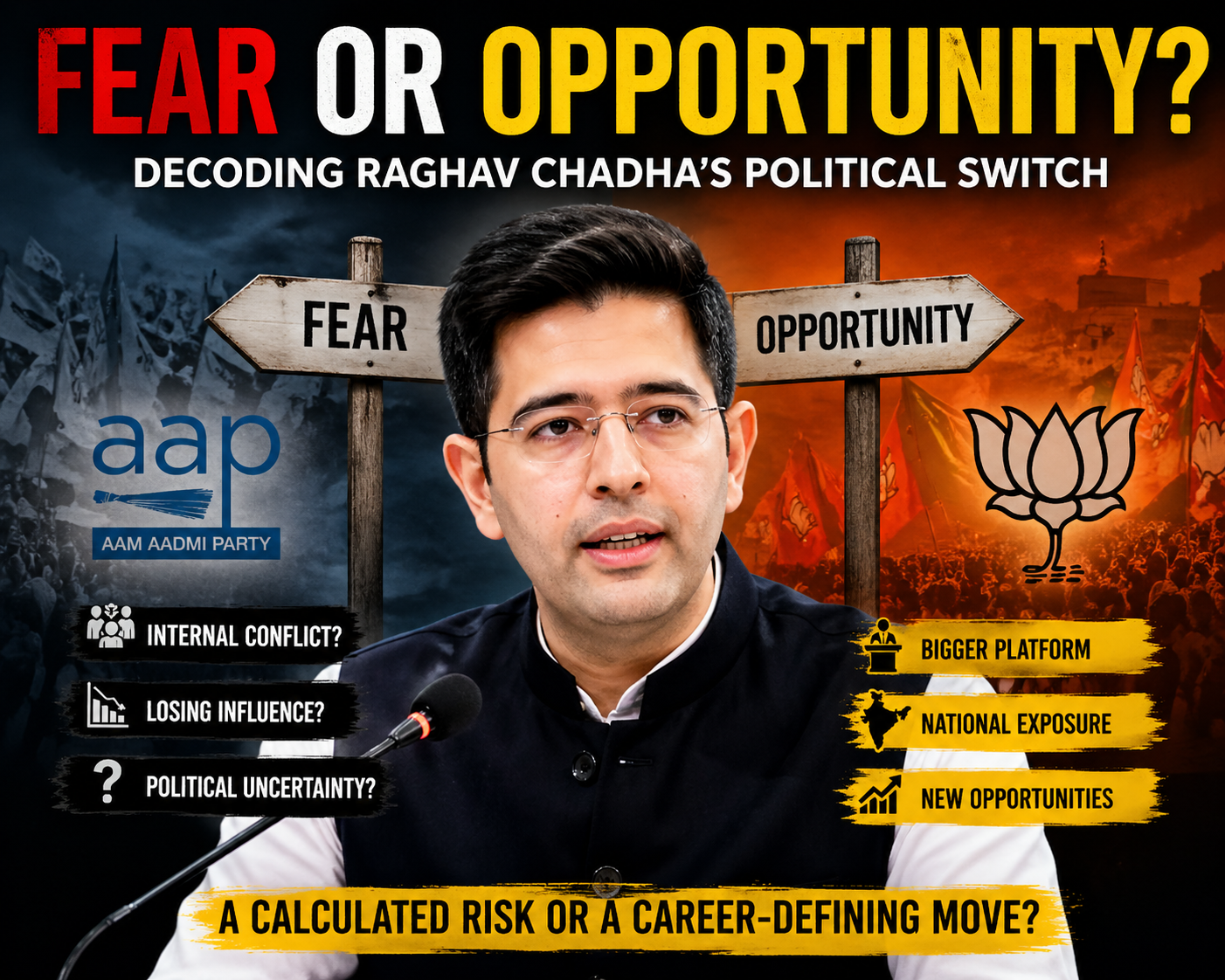
When a rising political figure changes sides, the narrative often splits into two extremes—fear or opportunity. The recent shift of Raghav Chadha from the Aam Aadmi Party (AAP) to the Bharatiya Janata Party (BJP) perfectly fits this debate.
Was this move driven by internal pressure and political uncertainty, or is it a calculated leap toward a bigger stage? Let’s unpack both sides.
The Fear Narrative: A Move for Survival?
Politics is as much about survival as it is about ideology. In this context, Chadha’s exit from AAP can be viewed through the lens of internal friction and diminishing influence.
Reports of strained relationships within the party and reduced responsibilities hint at a possible loss of positioning. For a leader who once stood close to Arvind Kejriwal, such shifts can signal uncertainty.
From this angle, the move raises questions:
- Was he being sidelined within AAP?
- Did internal dynamics push him toward a safer alternative?
- Was staying back a risk to his political future?
If these factors played a role, then the switch reflects fear of stagnation or political decline.
The Opportunity Angle: A Strategic Leap
On the other side, joining BJP can be seen as a forward-looking, strategic decision. BJP’s national dominance and organizational strength provide a larger platform for visibility and growth.
For a young and ambitious politician, this shift could mean:
- Access to national-level influence
- Better alignment with power structures
- A chance to reinvent his political trajectory
In this sense, Chadha’s move is not about escaping a problem—but about seizing a bigger opportunity.
Public Perception: Where the Real Battle Lies
Regardless of intent, perception has become the biggest challenge. Chadha built his image as a face of “new politics”—clean, consistent, and ideology-driven.
The switch has triggered mixed reactions:
- Supporters of BJP see it as a smart move
- Critics call it opportunistic
- Neutral observers view it as a calculated risk
The core issue isn’t just the switch—it’s the gap between past positioning and present action.
Fear vs Opportunity: The Reality
The truth likely lies somewhere in between. Political decisions are rarely driven by a single factor.
- Fear may have influenced the timing
- Opportunity may have shaped the direction
In modern politics, leaders often act where risk meets reward—and this move fits that pattern perfectly.
What This Means for Indian Politics
Chadha’s switch highlights a broader trend:
- Ideology is becoming more flexible
- Political careers are increasingly strategic
- Personal growth often outweighs party loyalty
It reflects a system where adaptability is as important as conviction.
Conclusion
So, is it fear or opportunity?
The answer isn’t black and white. Raghav Chadha’s move appears to be a blend of both—responding to internal challenges while stepping toward a larger platform.
What will truly define this decision is not the switch itself, but what comes next.
If he succeeds in building credibility and influence in his new role, it will be seen as opportunity.
If not, critics will remember it as a move driven by fear.
In politics, perception evolves—but results decide the final narrative.