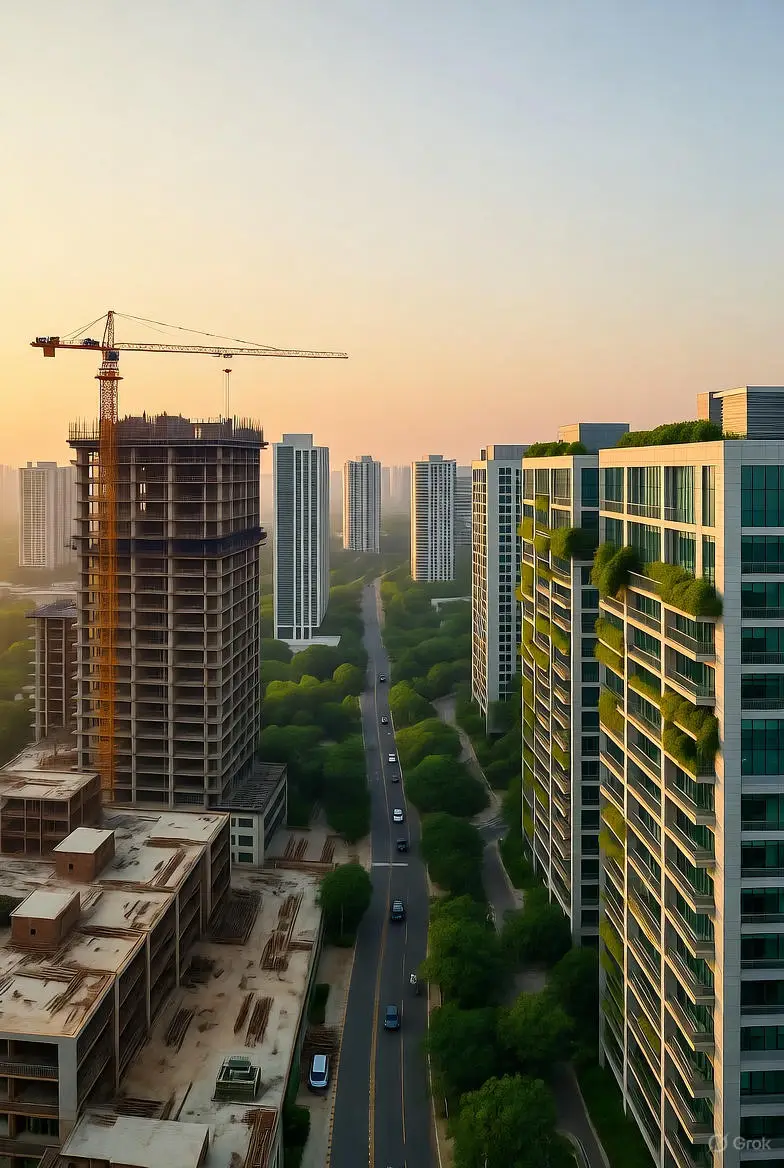
Reference to Hindustan times. Indian housing market has maintained the growth trend in the Q3 of 2025 and property prices in the big cities have risen by 719 percent. The need to own a better house, their prices being high to build and few willing to relocate houses were the key factors that have been behind the rush.
In Delhi, it experienced the highest price growth of nineteen percent in Delhi NCR.
According to the report by PropTiger.com entitled: Real Insight Residential: July to September 2025; the city of Delhi NCR has the greatest change in the year on year percentage change of nineteen percent and nine point eight percent change in quarter on quarter basis because of the increased demand of luxurious housing and development of infrastructure within the area.
Over the period between the Q3 2024 to Q3 2025, the housing price per square foot in the city of Delhi NCR increased by fifteen percent, which is one of the highest housing price growths in the Indian metros per year.
The growth in single digits was recorded in Bengaluru and Hyderabad.
Bengaluru was also a favorable investment destination and the growth was fifteen percent and twelve point six percent per annum and quarter to quarter respectively. This is the constant inflow of employment in the IT sector and the initiation of these high-end projects that increased the average price of the property in the city that had previously been 7,713 to 8,700 per square foot.
The city also recorded a large growth of thirteen and four point six percent in the annual and quarterly growth on the prices per square foot in Q3 2024 and Q3 2025 respectively, 6,858 rupees, and 7,750 rupees.
Continued growth on other strategic markets.
The other major markets which experienced single-digit growth of between seven percent and nine percent were the Mumbai Metropolitan Region (MMR), Pune and Chennai and Kolkata. This tendency demonstrates the general confidence of the developers and readiness of the buyers to invest in the raising of the real-estate prices in India.
The high value projects also help in increasing the market value.
Despite the variation in sales volume of the homes sold in the eight major markets decreasing by one per cent annually to 95,547 units, the overall sales value demonstrated an increasing growth to the year of 1.52 crore. The numbers are indicative of the apparent propensity towards the premiumisation trend and the customers are more interested in high end and luxurious developments and not in low-cost housing.
New products: hope of new introduction.
In general, the housing that was being provided in the larger cities was also reported to have also reduced by 0.1 percent per annum to 91,807 units. However, the new entries reported an increase of nine point one percent on a quarter to quarter basis which is an indicator of a cautious but positive spirit of developers in line with the recent market demand.
The western and southern part of India had most of the innovation topography and the best ones were MMR (26.9 percent), Pune (18.7 percent) and Hyderabad (13.6 percent). Of all new projects started in these cities the number of new projects started in JulySeptember quarter is approximately sixty percent of the total number of new projects started in these cities.
Developers are emphasizing on high value offers.
The developers are now targeting the construction of high-quality and luxury developments as per the report to meet the increasing demands of the buyers. Infrastructure in centres of the cities is better and as the disposable income increases, the demand to quality housing will continue to rise.
Eight best cities of the report.
The study indicates that the most active residential markets in India are Ahmedabad, Bengaluru, Chennai, Hyderabad, Kolkata, NCR (Gurugram, Noida, Greater Noida, Ghaziabad and Faridabad) MMR (Mumbai, Navi Mumbai and Thane) and Pune.
Key takeaway
The fact that the property prices in large cities in India have had a steady performance in their growth process justifies the fact that the real-estate property is straining and the pressures associated with quality house accommodation are forcing the developers to formulate a strategic mode. Due to the process of infrastructure development that is still underway and the improvement of the economy, the analysts assume that the residential prices will also continue rising until 2026.
Looking for website Designing ? Connect with wovved today.