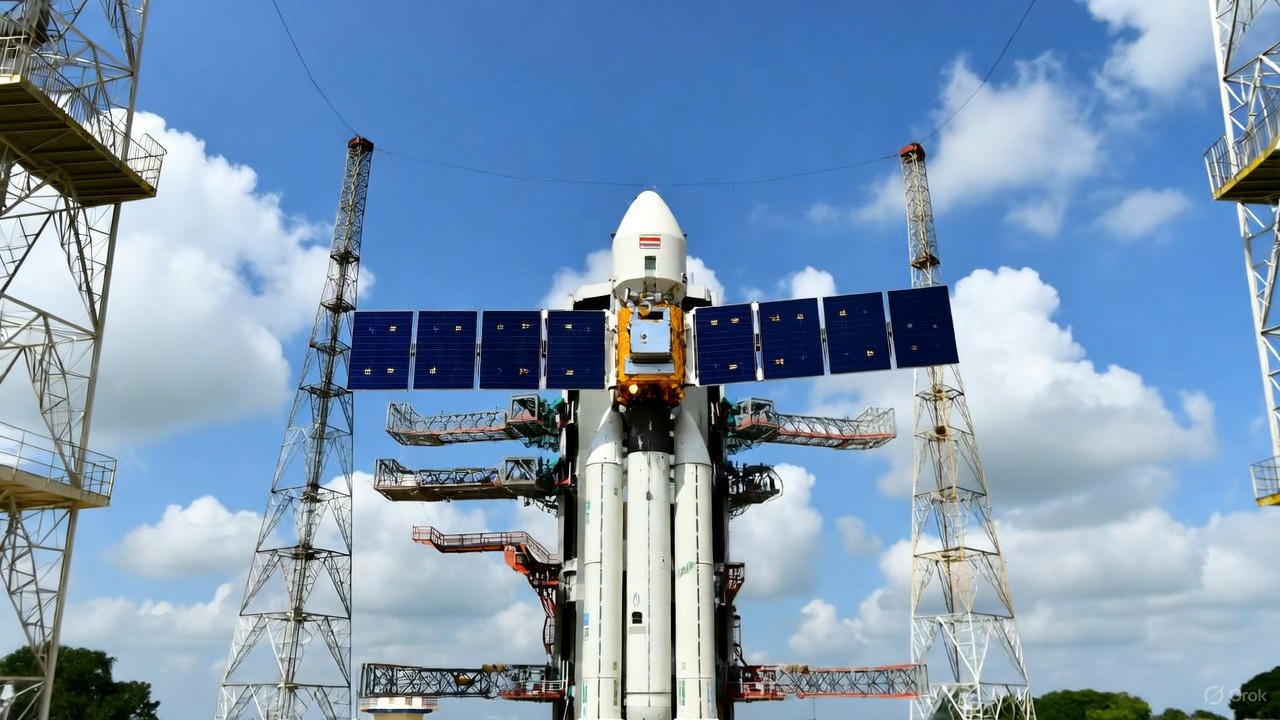
Reference to Times of India .The Indian Space Research Organisation (ISRO) this Sunday made a historic success in the space and defence program in India by launching CMS-03 (GSAT-7R) into orbit which is the heaviest communication satellite in the country at 4,410 kilograms. The launch was conducted on the reliable rocket ship LVM3-M5 of the Satish Dhawan Space Centre in Sriharikota, another successful success story in the history of the Indian space.
A Giant Leap to Aboriginal ways of naval communication.
The GSAT-7R satellite will make the sphere of communication of the Indian Navy much faster within the strategic areas of the Indian Ocean (IOR). It is planned to replace the 10-year-old GSAT-7 (Rukmini) launched in 2013 that will ensure high capacity rates, safe communications between the naval vessels, submarines, aircrafts, and Maritime Operations Centres.
Indian Navy uses GSAT-7R as an important step of self-reliance in the local technology. The satellite fuses several sophisticated systems which encompass multi-band transponders which may be employed to transmit voice, video and data through frequencies of frequency of UHF, S-band, C-band and Ku-band.
This mission reiterated our intention to protect the Indian maritime interest through high-technology which was in-house and would improve the real time operation coordination even in challenging security environments, a spokesperson of the Navy added.
Rocket of Bahubali Historic Performance.
The Bahubali, a heavy-lift vehicle, sent GSAT-7R into a sub- Geosynchronous Transfer Orbit (sub-GTO) approximately 16 minutes following its launch into the atmosphere by the rocket, named after ISRO. Its perigee was 26,700 km and it marked the first time that ISRO was able to give successful re- ignition of the cryogenic upper stage a critical in-orbit capability.
V. Narayan who is the Chairman of ISRO affirmed that the payload capacity of the LVM3 had been raised by 10 percent which offered it the power to launch the heaviest satellite ever to be launched in Indian soil. Even in rough weather the car was very effective. The satellite will prove to have a 15-year service life bearing some of the new technologies attached to it and with the addition of Narayanan.
SOTA Technology, 100 percent Indian manufactured.
According to M. Sankaran, Director of UR Rao Satellite Centre, GSAT-7R was equipped with 1, 200-litre propulsion tank, collapsible antenna systems amongst other indigenous components and these were meant to serve the navy. Everything is functioning properly. Sankaran guaranteed that the satellite was fine and all the valves opened after the launch as expected.
In the instance of 4,000 kg or above mass satellites, ISRO has been making use of foreign launch vehicles so far. By this mission, it became an official new dawn of heavy launching of the communication satellites in India using local rockets.
Raising Prospects in Indian Maritime.
The introduction of the GSAT-7R does not just mark the appreciation of the proficiency of the engineering capabilities of the ISRO but it gives India an edge in the event of strategic autonomy in defence communications. Its usage will revolutionize the operational performance of the Navy in the Indian Ocean Region because it has enhanced level of coverage, bandwidth and protection of information transfer.
This launch is a masterpiece in the national search of technological self-sufficiency, unlike any other occasion in the history of the world at large and maritime security at large, GSAT-7R is the product of the Indian determination to be on top with invention, accuracy and independence, therefore the launch is an epitome in the national quest of having technological self-sufficiency.
Looking for website Designing ? Connect with wovved today.