Filed from the Department of Geopolitical Proportion, where the maps are large and the populations are not.
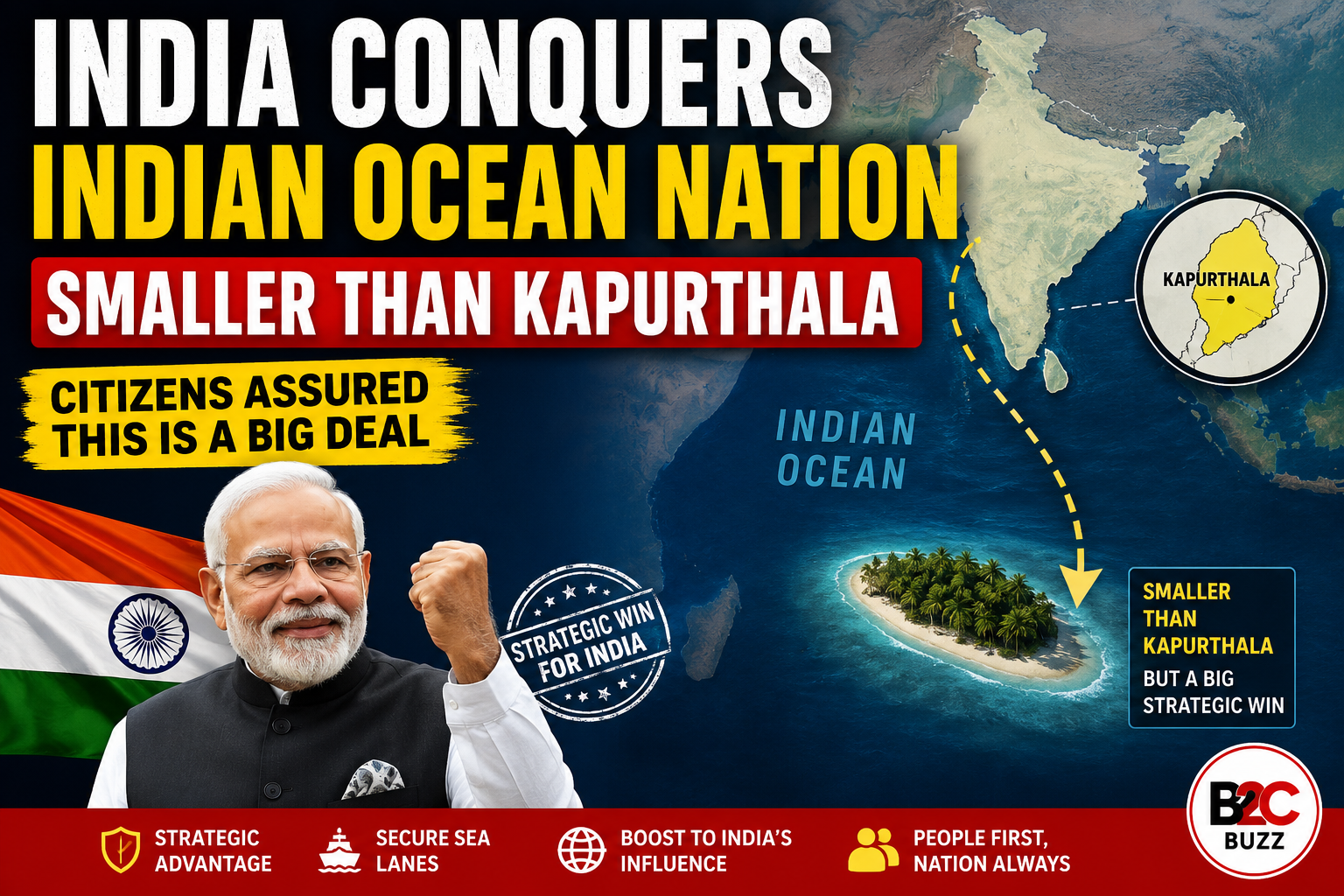
In a triumph of diplomacy that historians will surely struggle to locate on a standard atlas, India this week extended the warm hand of friendship across 4,000 kilometres of open ocean to Seychelles — a sovereign nation whose entire population, roughly 130,000 people, could comfortably go missing inside a single mid-sized Indian town and nobody would file a report.
To put the stakes in perspective: Seychelles has fewer residents than the queue at a Delhi passport office on a Monday. Its whole citizenry would not fill the smallest Class I city in India, and would rattle around inside Mumbai like a single chickpea in an empty stadium. Naturally, this called for a three-day State Visit, a fast patrol vessel, a Line of Credit worth ₹1,250 crore, and the historic distinction of becoming the first Indian PM to address a National Assembly that could, if pressed, hold its sessions in a generously sized banquet hall.
A Strategic Masterstroke, We Are Told
Sources speaking on condition that we sound impressed confirm that the visit was “deeply strategic.” When asked to elaborate, the sources gestured vaguely at a map of the Indian Ocean and said the word “MAHASAGAR” with great conviction, the way one says a password one has memorised but not understood.
The centrepiece deliverables included agreements on UPI, space cooperation, agriculture, shipping, health, and — in a flourish that suggests genuine forward planning — extradition. Yes. Extradition. Between India (1.4 billion people) and Seychelles (a number you could verify by counting). One can only assume the criminal masterminds of the subcontinent have long dreamed of fleeing to a 460-square-kilometre archipelago where there are precisely zero places to hide and everyone has met everyone else twice.
“We have closed the Seychelles loophole,” a diplomat did not say, but absolutely should have.
UPI: Now Accepted at All Six Coconut Stands
The crown jewel of the trip is the rollout of UPI in Seychelles, finally allowing the nation’s citizens to scan QR codes with the same effortless grace as a Bengaluru autorickshaw driver. Analysts predict the move will revolutionise the local economy, which is great news for the local economy, both of whose shopkeepers are reportedly thrilled.
Industry observers note that with UPI live, a Seychellois citizen can now split a restaurant bill instantly — a transaction previously requiring the unbearable friction of cash, or simply remembering who owes whom in a country small enough that you’ll see the person again tomorrow anyway.
The Patrol Vessel Arrives, Threatening No One in Particular
India also handed over a “Made in India” Fast Patrol Vessel, christened with appropriate gravity, alongside six ambulances, ten utility vehicles, and five laser radial boats. The hardware is intended to bolster maritime surveillance across Seychelles’ Exclusive Economic Zone — a vast stretch of ocean guarding a landmass roughly the size of an ambitious suburb.
Defence commentators were quick to clarify that this is, in fact, important: the Indian Ocean is a chessboard, the shipping lanes are critical, and a certain large neighbour to the north has been distributing infrastructure and goodwill across the same waters with the relentless cheer of a man handing out flyers. So while the optics — a superpower gifting a navy to a nation of 130,000 — may read as mildly theatrical, the subtext is a perfectly rational game of “whoever befriends the small island first, wins.” Seychelles, for its part, gets free boats. Seychelles is winning.
The Numbers, For Those Who Enjoy Suffering
Let us linger, lovingly, on the arithmetic.
- Seychelles population: ~130,000
- People who attend a single IPL match at a big stadium: also roughly that
- Indians added to the population during the three-day visit: comfortably more than the entire population of Seychelles
- Diplomatic pageantry deployed: enough for a G20
This is not to say the visit lacked meaning. On the contrary — it had so much meaning that the meaning had to be imported in bulk, because the host nation, charming as it is, simply does not generate meaning at industrial scale. India brought the gravitas. Seychelles brought the beaches. A fair trade, frankly.
“First Indian PM to Address the National Assembly”
A genuine historical first, and we mean that. No Indian Prime Minister had previously addressed the Seychelles National Assembly, possibly because the opportunity had not arisen, possibly because the Assembly is small enough that previous PMs assumed they could just text everyone.
The address reportedly emphasised shared democratic values, rule of law, and people-centric governance — all excellent things, and all considerably easier to govern when your entire electorate could be invited to a single wedding with seating to spare.
In Conclusion: A Win, Probably
Strip away the comedy and there is, irritatingly, a real point underneath: small islands sit on big oceans, and big oceans decide who controls trade, fuel, and fish. Seychelles’ 130,000 people happen to live on real estate worth far more than their headcount suggests, and the superpower that shows up with patrol boats and payment systems tends to be the superpower that gets the port. So India flew across the sea, signed the deals, gifted the vessel, and planted the flag of friendship in a nation it could relocate, in its entirety, into a single Delhi neighbourhood.
It was, by every metric except population, a very big visit.
This is a work of satire and opinion, published as commentary. The underlying facts it riffs on — the State Visit, the agreements on UPI, space, agriculture, shipping, health and extradition, the reported ₹1,250 crore Line of Credit, the Fast Patrol Vessel and associated equipment, the address to the National Assembly, and the population figures for Seychelles and Indian cities — are drawn from public reporting and official readouts and are stated accurately to the best of our knowledge. Everything else — the tone, the jokes, the comparisons, and the views expressed — is the personal opinion and comic exaggeration of the author and is not presented as fact. No statement quoted or paraphrased here is attributed to any real, named individual as their genuine words. Any “sources,” “analysts,” “commentators,” “diplomats,” or “this columnist” are rhetorical devices of the satire, not real persons. No disrespect to any individual, office, or nation is intended.