A B2C Buzz in-depth feature
India sits on a paradox. It runs some of the largest water-conservation programmes in the world, has spent well over a lakh crore rupees on recharge in recent years, and its own official data shows a slow national improvement — yet across a wide belt of the country, the water beneath our feet is still vanishing faster than it returns. The monsoon arrives every year like a reprieve, but in the states that need it most, even record rainfall no longer refills the aquifers.
This is the story of that paradox: how bad the crisis really is, what the government is genuinely doing about it, why we keep lagging despite the effort, and a practical roadmap — including one proven intervention already working in Punjab — for actually reversing it.
Part 1: The scale of the problem
India is the single largest user of groundwater on Earth, drawing roughly a quarter of all groundwater extracted worldwide. According to the Central Ground Water Board’s (CGWB) Dynamic Groundwater Resources Assessment 2025, the country extracts about 247.22 billion cubic metres (BCM) a year — a volume that rivals the combined extraction of the United States and China.
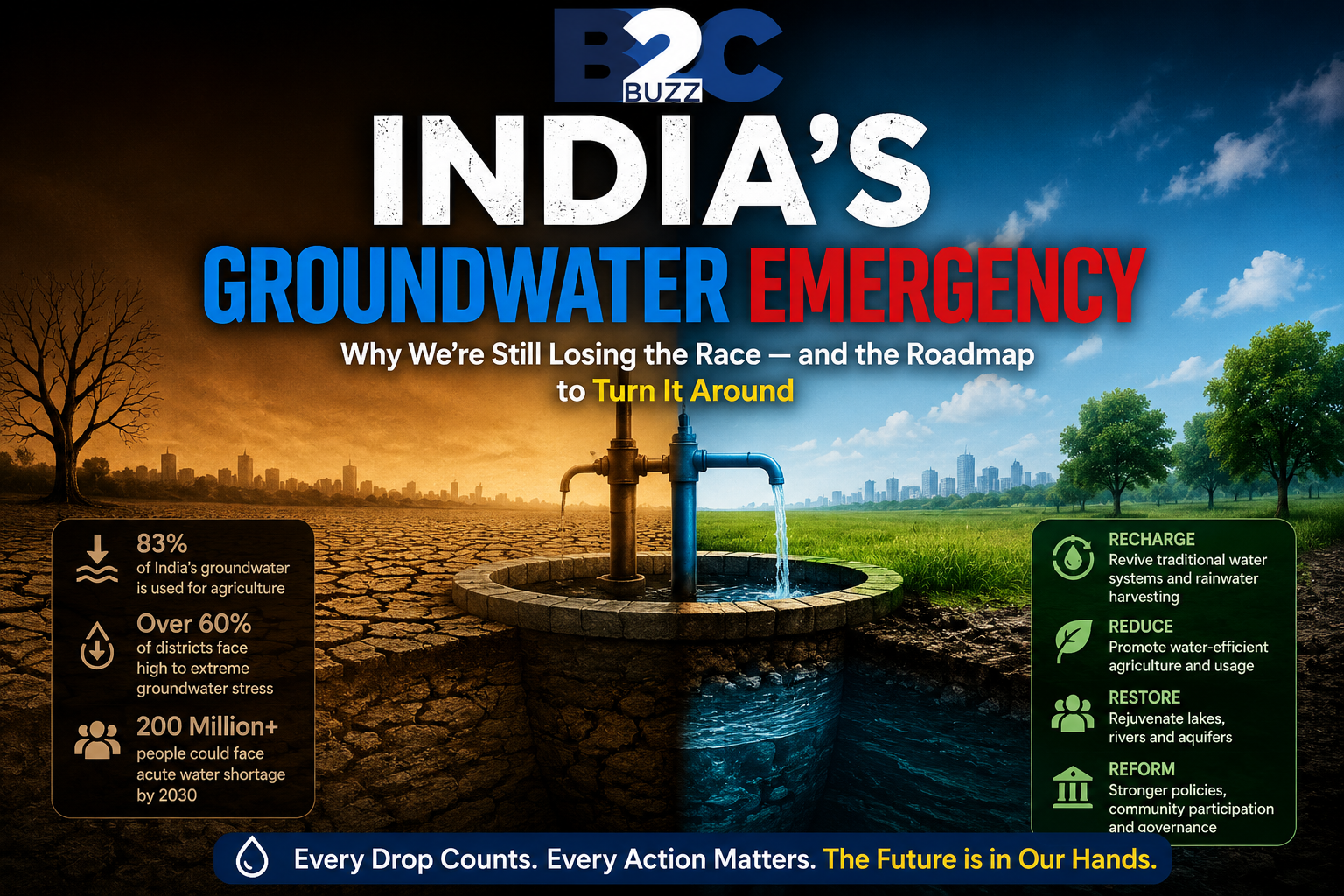
We depend on it almost totally. Groundwater irrigates the majority of India’s farmland, supplies over 80% of rural drinking water, and meets nearly half of urban demand. When it fails, everything above it — food, health, incomes — fails with it.
The national headline figures look, on paper, cautiously reassuring. Total annual recharge stands at 448.52 BCM against extractable resources of 407.75 BCM, giving a national Stage of Extraction of 60.63% — technically within the “safe” band. Officially, the trend is even positive: the share of “safe” assessment units rose from 62.6% to 73.14% between 2017 and 2025, while over-exploited units fell from 17.2% to 10.8%.
But national averages hide the emergency. Of India’s 6,762 groundwater assessment units (blocks, talukas, mandals), about 26% are classified as over-exploited, critical or semi-critical — chronic depletion concentrated in Punjab, Haryana, Rajasthan, Karnataka, Madhya Pradesh, Tamil Nadu, Delhi, Uttar Pradesh and Puducherry.
The worst-hit zones
The regional extremes are where the crisis is real:
- Punjab extracts over 150% of its annual recharge. It now has more than 15 lakh tubewells, up from just 1.9 lakh in 1970, and over 80% of its blocks are over-exploited. Borewells that once struck water at 30 feet now go down 80–200 feet.
- Rajasthan is the most over-exploited state in proportionate terms, drawing roughly 149 units for every 100 recharged. In 2024–25, 214 of its 302 assessed units were over-exploited — despite a record-wet monsoon that year delivering 156% of its long-period average rainfall. Even that could not refill the aquifers, a stark warning about how deep the deficit runs.
- Haryana has seen its water table fall by an average of 5.41 metres in a decade. Of 143 assessment units, 88 are over-exploited.
- Delhi has crossed the “over-exploited” mark, trailing only Haryana, Punjab and Rajasthan.
It’s no longer just about water
Two consequences make this more than an agricultural statistic.
First, over-pumping is physically sinking the land. Satellite studies of Delhi-NCR show land subsidence exceeding 11 cm/year near IGI airport and around 3 cm/year in Faridabad — both tracking the falling water table. This is a structural-safety issue for a densely built region.
Second, quality is collapsing alongside quantity. The CGWB Annual Ground Water Quality Report 2025, based on nearly 15,000 samples, found that 28.3% exceeded permissible limits for at least one parameter. Nitrate is the most widespread contaminant, worst in Rajasthan (50.5% of samples). Uranium peaks in Punjab (62.5% post-monsoon), followed by Haryana and Delhi. Alarmingly, in some aquifers, monsoon recharge now pushes pollutants deeper rather than diluting them — meaning the annual “reprieve” can quietly worsen contamination.
Part 2: What the government is already doing
The response is neither small nor new. A cluster of national schemes forms a genuine recharge architecture.
Master Plan for Artificial Recharge to Groundwater (2020) is the national blueprint. CGWB has planned around 1.42 crore rainwater-harvesting and artificial recharge structures nationwide, with the potential to capture roughly 185 BCM of water.
Atal Bhujal Yojana (ABY) is the flagship community-led scheme — around ₹6,000 crore, half funded by the World Bank — operating in over 80 water-stressed districts across seven states (Gujarat, Haryana, Karnataka, Madhya Pradesh, Maharashtra, Rajasthan, Uttar Pradesh). It has built or rejuvenated over 83,000 recharge structures using village-level water budgeting, and runs until 30 September 2026.
Jal Shakti Abhiyan / “Catch the Rain” drives mass rainwater harvesting and water-body rejuvenation. Roughly ₹1.5 lakh crore has been spent since 2021 through MGNREGS convergence alone on these works.
MGNREGS water mandate: Under the National Initiative on Water Security (September 2025), at least 65% of MGNREGS funds must go to water conservation in over-exploited and critical blocks, and 40% in semi-critical blocks — directing rural labour money precisely where depletion is worst.
National Aquifer Mapping (NAQUIM): CGWB has mapped about 25 lakh sq km — nearly the entire mappable area of the country — delineating aquifers and preparing block-level management plans. This is the scientific foundation that tells planners where recharge will actually work.
PMKSY (Pradhan Mantri Krishi Sinchayee Yojana) funds watershed development and micro-irrigation (drip and sprinkler) to cut demand, since irrigation consumes roughly 87% of extracted groundwater.
State-level action varies widely. Rajasthan’s Mukhyamantri Jal Swavlamban Abhiyan improved water levels in over 50% of monitored wells. Delhi’s borewell regulation and rainwater-harvesting incentives are credited with shifting Dwarka from land subsidence to measurable uplift — a rare, documented reversal. And Punjab’s canal revival, covered below, is the standout success.
One structural caveat frames all of this: water is a State subject. The Centre largely provides technical and financial assistance while States implement — which is precisely why results are so uneven.
Part 3: The proven intervention — Punjab’s canal shift
Amid the gloom, one state offers hard evidence that the crisis can be reversed by fixing the right lever.
Punjab has aggressively revived its canal network to replace tubewell pumping with surface water. Canal irrigation coverage surged from 26.5% in 2022 to roughly 78% by early 2026. Over 102 defunct canals were restored — some existing only in official records — and canal water reached 1,446 villages for the first time since Independence.
The regional numbers are striking. The Ropar Canal Network’s irrigated area jumped from 29,488 to 85,447 acres in a single year, a near-200% rise. The Bist Doab Canal revival added over 1.10 lakh acres in the Doaba region.
Crucially, it is showing up in the aquifer. Overall groundwater extraction in Punjab fell from 164% in 2023 to 156% in 2025, and over-exploited blocks dropped from 117 to 111. Water levels improved in 81 of Punjab’s 153 blocks, which officials attribute primarily to increased canal-water use. A CGWB report separately noted improvement in 74 blocks, with four moving out of the “critical” category.
The honest caveat: at 156% extraction, Punjab is still deeply over-exploited — less deep in the hole, not out of it. Around 14 lakh tubewells remain active, water-guzzling paddy still covers 31 lakh hectares, and part of the 2023–24 recovery was aided by floods, not policy alone. But the direction of travel is unmistakable, and it proves the central point: substitute the water source, relieve the aquifer.
Part 4: So why are we still lagging?
If the schemes are this extensive and the spending this large, why does the crisis persist? The answer, consistent across official reports and independent analysts, is uncomfortable: the schemes work on the supply side (putting water back), while a set of powerful policies actively pushes farmers to pump more on the demand side. You cannot refill a bucket faster than you are draining it — and much of the time, the state is funding both the filling and the draining.
1. The demand side is subsidised to over-pump
Free or heavily subsidised farm electricity means the marginal cost of pumping is effectively zero — so there is no incentive to conserve, and pumps are sometimes run simply to exhaust a power quota. Layered on top, the Minimum Support Price (MSP) for paddy and sugarcane is a perverse incentive: guaranteed procurement makes it financially rational to grow water-guzzling crops in semi-arid zones where they don’t belong. The Jal Shakti ministry’s own standing committee has acknowledged that subsidised electricity drives over-extraction. In effect, one arm of government funds recharge while another pays farmers to drain the aquifer.
2. Enforcement barely exists
Regulation is largely paper. By one estimate, only about 14% of over-exploited blocks are officially notified — and notification is what triggers extraction controls. Roughly 70% of extraction remains unregulated, partly because a colonial-era legal principle still ties groundwater rights to land ownership: own the land, pump what’s beneath it, with essentially no cap. There is no real-time extraction monitoring, so borewell drilling continues unchecked even in over-exploited blocks, despite all the aquifer mapping.
3. Fragmented governance
With water a State subject, the Centre funds and maps while States execute — and State capacity varies enormously. Responsibilities are scattered across irrigation departments, municipal bodies, groundwater authorities and pollution boards with little coordination, so a good national scheme lands unevenly.
4. Reform is politically radioactive
Every genuine fix — cutting free power, capping paddy procurement, pricing water — hits farmers directly. The 2020–21 rollback of the farm laws after nationwide protests showed how sensitive any change to procurement is. So governments favour visible, popular supply-side works over the unpopular demand-side reforms that would actually close the gap. Enforcement carries political costs, so it rarely happens.
5. The fixes themselves are often designed to fail at scale
Crop-diversification incentives tend to be single-season and can’t match the income certainty of assured rice procurement — Haryana’s ₹17,500/ha millet scheme (2024) didn’t scale for exactly this reason. Flood irrigation still dominates (80–85% of farmers) despite micro-irrigation being available. And the sheer scale of extraction overwhelms recharge gains — even the good monsoons of 2023–25 couldn’t keep pace.
The one-line diagnosis: We lag not because of a spending problem — roughly ₹1.5 lakh crore has gone in since 2021 — but because of an incentive and enforcement problem. The schemes treat the symptom (empty aquifers) while the disease (free power + MSP + zero enforcement + fragmented governance) is left untouched, and often actively funded. Where a state fixed the incentive — Punjab substituting canal water — the numbers actually moved.
Part 5: The roadmap — “Recharge India”
A workable plan must be judged by one test: does each measure fix an incentive, or merely build a structure? Organised by workstream rather than timeline, here is that plan.
Workstream 1 — Foundation and targeting
Digitise CGWB’s block-level classification into a public, transparent dashboard. Rank the roughly 1,750 stressed blocks by recharge deficit so priority is data-driven, not political. Route funding through existing rails (Atal Bhujal Yojana, PMKSY, MGNREGS) rather than a new bureaucracy.
Workstream 2 — Supply side (recharge)
Scale the Master Plan’s 1.42 crore recharge structures, prioritising red-zone blocks. Enforce — with real inspection, not paper compliance — the rooftop rainwater-harvesting rules that already exist in Delhi, Tamil Nadu, Rajasthan and elsewhere. Revive village ponds, baolis and check dams through MGNREGS labour.
Workstream 3 — Demand side (the decisive lever)
Replicate Punjab’s canal-substitution model wherever surface water can reach. Expand micro-irrigation to replace flood irrigation. Push crop diversification away from paddy in Punjab and Haryana, backed by multi-year income guarantees rather than one-season schemes. Meter agricultural power and shift toward direct benefit transfer for electricity, so conservation finally has a reward. Without this workstream, the others cannot succeed.
Workstream 4 — Delivery mechanism
Adopt a “single-call recharge-as-a-service” model to remove the paperwork barrier that stops small farmers: a toll-free registration line, government-empanelled agencies handling everything from survey to construction and maintenance, farmers contributing a small patch of land instead of cash, and geo-tagged milestone payments to prevent leakage. The farmer retains ownership and gets priority access to the stored water.
Workstream 5 — Monitor and institutionalise
Continuous satellite plus in-situ monitoring feeding the public dashboard, so every stressed block has a visible recharge trajectory. Community aquifer-management committees on the Atal Bhujal model. Mandatory recharge structures in all new construction and larger farmland above a threshold.
The research backbone
A programme this large needs a parallel evidence engine: block-level aquifer mapping (extending NAQUIM); before-and-after impact measurement for every intervention; study of the quality–quantity interaction (where recharge drives contaminants deeper); behavioural and policy economics of power pricing and MSP; and continued subsidence tracking in Delhi-NCR, where depletion is a structural risk, not only a water one.
Conclusion: a solvable crisis, if we fix the incentive
India’s groundwater story is not one of neglect. The schemes exist, the money flows, the science is mapped. What’s missing is the courage to fix the demand-side incentives — free power and MSP-driven cropping — and the enforcement to make regulation real. Punjab’s canal revival is the proof of concept: change what drives extraction, and the aquifer responds. Dwarka’s shift from sinking to rising says the same.
The monsoon will keep arriving. Whether it recharges a recovering aquifer or drains into an over-pumped void is, ultimately, a policy choice — not a natural one.
Sources: Central Ground Water Board — Dynamic Groundwater Resources Assessment 2025 and Annual Ground Water Quality Report 2025 (Ministry of Jal Shakti, PIB); Observer Research Foundation; SANDRP; The Tribune; Down To Earth; and allied policy analyses, 2025–2026.