By B2C Buzz | Business Desk
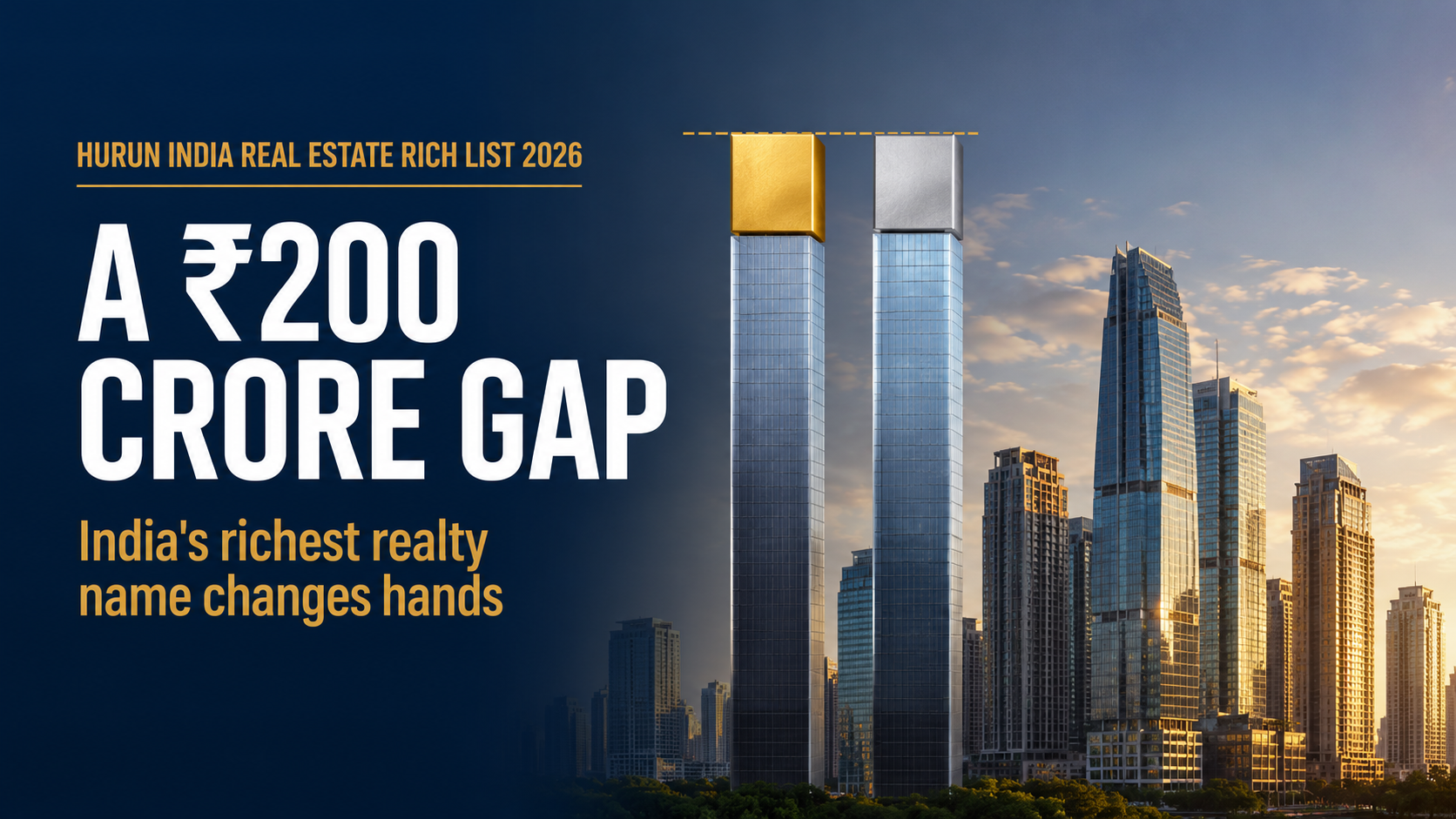
For nearly a decade, one name sat unchallenged at the summit of Indian real estate wealth: Rajiv Singh of DLF. That streak has ended. Gautam Adani and family have claimed the number one spot on the GROHE-Hurun India Real Estate Rich List 2026 with ₹90,400 crore, overtaking DLF’s Rajiv Singh and family — by a margin so thin it would barely register as a rounding error in most rankings.
The gap: ₹200 crore. On a base of ₹90,000 crore-plus, that is a difference of roughly 0.2%.
The headline is real. But the story behind it is not the one being shared across LinkedIn and property-influencer feeds this week.
The Numbers
| Rank | Name | Company | Real Estate Wealth |
|---|---|---|---|
| 1 | Gautam Adani & Family | Adani Properties | ₹90,400 crore |
| 2 | Rajiv Singh & Family | DLF | ₹90,200 crore |
| 3 | Mangal Prabhat Lodha & Family | Lodha Group | ₹67,700 crore |
Gautam Adani and family climbed two places to become the richest names in Indian real estate with a wealth of ₹90,400 crore, up 73 percent from last year. Adani Properties recorded the highest absolute gain in valuation among Indian real estate companies this year, rising 72.5% year-on-year to ₹90,400 crore, according to the 2026 Grohe-Hurun India Real Estate 150 report.
That is a jump of ₹38,000 crore in a single year — the largest absolute value addition anywhere in the Indian property sector.
Why Adani Rose: Consolidation, Not Just Construction
The most important fact in this story is one the celebratory graphics tend to skip.
The rise follows the Adani Group’s move to consolidate its real estate operations under Adani Properties. Multiple land, township and development interests scattered across group entities were brought under a single roof — and when Hurun applied its valuation methodology to the consolidated entity, the number that emerged was dramatically larger than the sum of its previously fragmented parts.
The second factor is ownership structure. The gains propelled Gautam Adani and family to the top of the Grohe-Hurun India Real Estate Rich List for the first time, with a wealth of ₹90,400 crore, up 73 per cent YoY, as the family has full ownership of the real estate business.
This is the quiet mechanic doing most of the work. Adani Properties is unlisted and 100% family-owned. Every rupee of its assessed value flows directly into the family’s personal wealth column. Listed developers like DLF operate with public shareholders, institutional investors and free float — the promoter family captures only their proportional stake.
Put simply: Adani did not necessarily build more real estate than DLF this year. He owns all of his, and he put it all in one box.
There is a third caveat worth stating plainly. Adani Properties is unlisted, which means ₹90,400 crore is Hurun’s estimate, not a market-determined price. No exchange validates it daily. DLF’s valuation, by contrast, is set by thousands of traders every session. Comparing the two as if they carry equal certainty is a category error — one number is a measurement, the other is an appraisal.
Why DLF Fell: The Overtake Was Half a Slide
Here is the part almost entirely absent from the viral version of this news.
Despite the change at the top of the rich list, DLF retained its position as India’s most valuable real estate company with an enterprise value of ₹1.46 lakh crore, even after a 29.3% decline in valuation.
DLF lost nearly thirty percent of its valuation this year. Lodha fared worse — Lodha Developers retained the second spot with a valuation of ₹93,700 crore, down 32.2 per cent YoY. Indian Hotels Company also remained in the third position with a valuation of ₹93,300 crore, down 13.9 per cent YoY.
So the accurate framing is not “Adani overtook DLF.” It is closer to: Adani rose sharply through a structural reorganisation while the incumbent leaders fell sharply, and the two lines crossed. With DLF flat year-on-year instead of down 29%, this headline does not exist.
The Sector Itself Is Having Its Worst Year in Nearly a Decade
This is the context that reframes everything.
The combined valuation of the 151 companies in the ranking rose just 2 per cent YoY to ₹16.5 trillion — the slowest growth since the list’s inception nine years ago, compared with 14 per cent growth in 2025.
According to Hurun, the slowdown coincided with a 20% decline in the BSE Realty Index, reflecting weaker investor sentiment amid geopolitical uncertainties and concerns surrounding artificial intelligence.
And even that anaemic 2% is propped up by newcomers rather than incumbent performance. The combined value held firm largely on the back of 37 new entrants, led by listed real estate trusts. Among existing companies, Adani Properties (addition of ₹38,000 crore) and Prism (OYO) (addition of ₹34,700 crore) accounted for roughly two-thirds of all value gained.
Read that again: two companies accounted for two-thirds of all value created across the entire Indian real estate sector. Strip out Adani and OYO, and the rest of the industry collectively barely moved.
The Company Ranking Tells a Different Story Than the Rich List
An important distinction the infographics blur: richest person ≠ biggest company.
| Rank | Most Valuable Real Estate Companies | Valuation | YoY |
|---|---|---|---|
| 1 | DLF | ₹1.46 lakh crore | −29.3% |
| 2 | Lodha Developers | ₹93,700 crore | −32.2% |
| 3 | Indian Hotels Company | ₹93,300 crore | −13.9% |
| 4 | Adani Properties | ₹90,400 crore | +72.5% |
The Ahmedabad-based company climbed four places to become the country’s fourth-most valuable real estate company while retaining its status as India’s most valuable unlisted real estate developer.
DLF’s company remains 62% larger than Adani Properties. Rajiv Singh ranks below Gautam Adani on personal real estate wealth purely because of how much of the pie each man personally holds — not because of what either company is worth.
Sector Composition: What the List Actually Contains
In 2026, hospitality accounted for 24 of the 151 companies, up from 22 last year, with a combined valuation of ₹2.85 trillion. Residential real estate dominated the 2026 Grohe-Hurun India Real Estate 150, accounting for 65 per cent of the companies, down 2 per cent YoY, followed by hospitality at 16 per cent, up 1 per cent YoY, and commercial at 13 per cent, down 1 per cent YoY.
The cut-off date for valuations was May 29, 2026.
The Structural Argument
Drawing a comparison with China’s property market, Anas Rahman Junaid, founder and chief researcher at Hurun India, said, “First, India must urbanise. It is critical to the next stage of our development, and that means our developers need to grow.”
It is a fair long-term point — and it sits uneasily beside a list showing the sector’s slowest growth in nine years and a 20% fall in the realty index.
B2C Buzz Verdict
The viral claim circulating this week is factually correct but contextually misleading.
What’s true:
- Adani did take the No. 1 spot, for the first time
- The figures — ₹90,400 cr / ₹90,200 cr / ₹67,700 cr — are accurate
- DLF does remain India’s most valuable listed real estate developer
What’s being left out:
- The lead is ₹200 crore — statistically indistinguishable at this scale
- The rise is driven by corporate consolidation and 100% family ownership, not sales velocity or project execution
- Adani Properties is unlisted — the number is an estimate, not a market price
- DLF fell 29% and Lodha fell 32%. The gap closed from both directions.
- The sector recorded its slowest growth in nine years at 2%
- Adani Properties is still only the 4th most valuable real estate company
The takeaway being pushed across social media — that this reflects “rapid evolution driven by large-scale developments, infrastructure growth and strong execution” — is marketing language, not analysis.
The honest reading: an ownership-structure and consolidation effect, occurring during one of the worst years Indian listed realty has had in a decade.
For homebuyers and investors in Delhi-NCR and beyond, the operative signal in this report is not who topped the rich list. It is that the BSE Realty Index fell 20%, that India’s two largest listed developers each shed roughly a third of their valuation, and that the entire sector managed 2% growth. That is the story worth reading.
Sources: GROHE-Hurun India Real Estate 150 Report 2026; Business Today; Business Standard; Free Press Journal. Valuation cut-off: May 29, 2026.