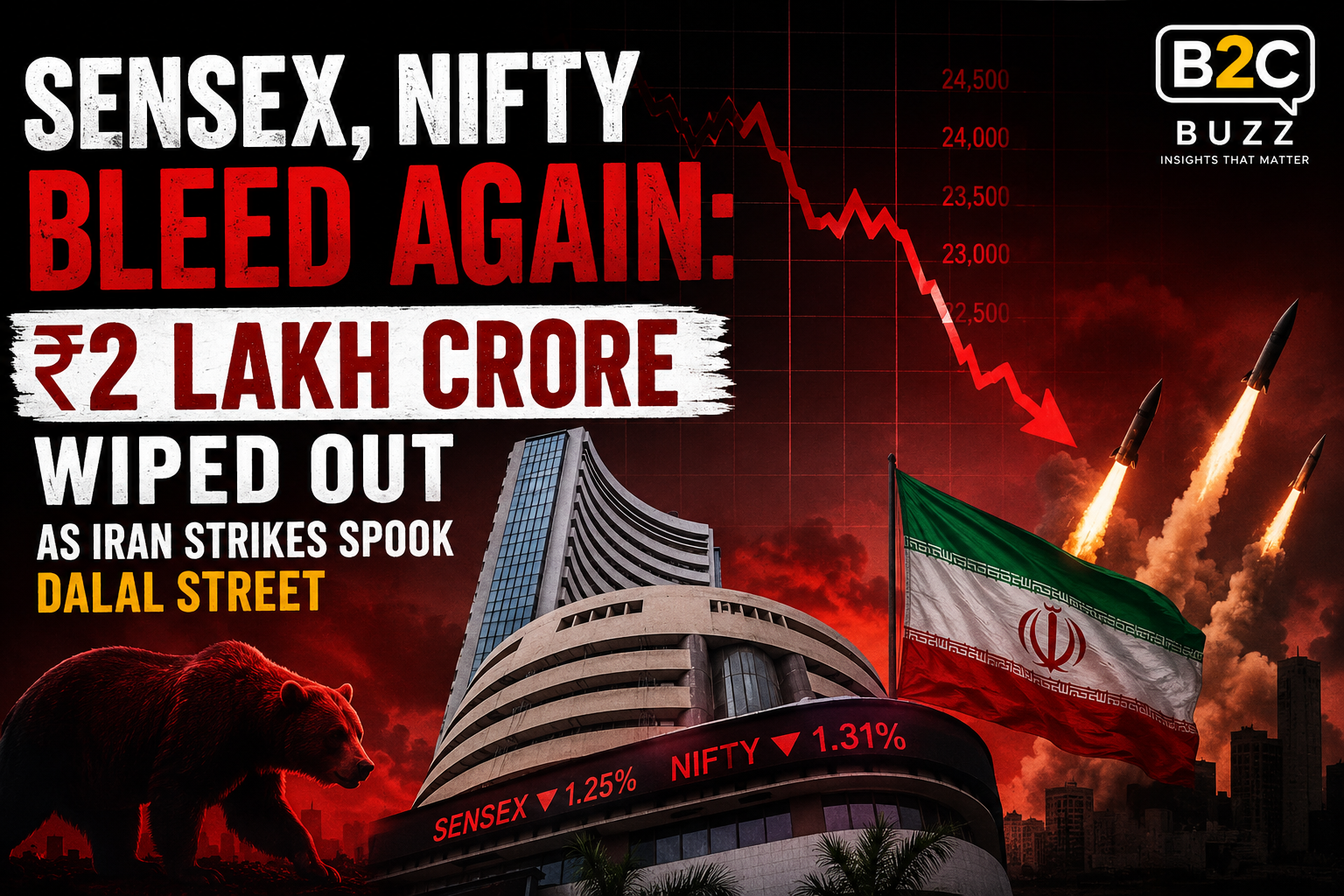
Indian equities extended their slide on Wednesday, July 8, 2026, as fresh US airstrikes on Iran, firming crude prices, and cautious pre-earnings positioning dragged the benchmarks lower. Here’s a breakdown of what’s driving the sell-off and what investors should watch next.
Dalal Street woke up to red screens once again. The benchmark indices opened with a gap-down on Wednesday, tracking weak global cues and a renewed flare-up in West Asia. By mid-morning, the BSE Sensex had shed over 540 points to trade near 77,640, while the Nifty 50 slipped below the 24,240 mark, down roughly 160 points. The broad-based nature of the fall — with midcap and smallcap indices sliding in tandem — pointed to jittery sentiment rather than an isolated stock story.
The damage was tangible: the sell-off erased close to ₹2 lakh crore in market capitalisation from BSE-listed companies, according to exchange data. So what exactly is pulling the market down? Here are the five key reasons.
1. Fresh US Airstrikes on Iran Reignite Geopolitical Fears
The single biggest trigger this week has been a sharp escalation in West Asia. Iranian state media reported US strikes on more than 80 targets linked to the Revolutionary Guard’s Quds Force, following an incident in which projectiles struck three tankers in the Strait of Hormuz. Washington also claimed to have hit dozens of Iranian patrol boats it described as an immediate threat to American forces.
Markets hate uncertainty, and an active conflict near one of the world’s most critical oil shipping lanes is exactly the kind of headline that sends risk assets lower. While US President Donald Trump signalled a possible de-escalation, saying Iran appeared to be “standing down,” the initial shock was enough to rattle investors across Asian markets.
2. Crude Oil Prices Are Firming Up
Geopolitics and oil are inseparable, and the Strait of Hormuz is the artery through which a large share of global crude flows. Any threat to this route pushes prices higher, and Brent has been under upward pressure through much of this cycle.
For India — which imports the bulk of its oil — rising crude is a double problem. It widens the current account deficit, pressures the rupee, and stokes fears of imported inflation. Oil & Gas and oil-marketing stocks were among the top laggards on Wednesday, reflecting exactly these anxieties.
3. Weak Global Cues from Wall Street
The mood overseas offered no comfort. US benchmarks — the Dow Jones, Nasdaq Composite, and S&P 500 — closed the previous session in the red after an overnight surge fizzled out. Asian markets traded mixed, with Japan’s Nikkei and Australia’s benchmark drifting lower, even as Hong Kong’s Hang Seng bucked the trend with a strong gain.
When Wall Street sneezes, emerging markets tend to catch a cold, and Wednesday’s negative handover set a cautious tone for Indian equities from the opening bell.
4. Caution Ahead of the June-Quarter Earnings Season
Investors are treading carefully as Q1FY27 corporate results begin trickling in. Early business updates have been a mixed bag — Titan cheered the Street with strong jewellery-led growth, while fashion retailer Trent came under heavy pressure after softer-than-expected quarterly revenue, plunging in double digits.
With valuations elevated after a multi-session rally, the market is in “show me the numbers” mode. Any earnings disappointment is being punished quickly, and that nervousness is keeping buyers on the sidelines.
5. Profit Booking After a Winning Streak
Context matters. Before this dip, the Sensex had strung together several consecutive sessions of gains, supported by steady foreign portfolio inflows, an improving monsoon outlook, and easing sentiment. That rally left the indices looking stretched in the short term.
A pullback of this nature is partly healthy profit-taking — investors locking in gains ahead of key events like the US Federal Reserve minutes and the domestic earnings deluge. Late-session selling that erased intraday gains earlier in the week was an early sign that some froth was being shaken off.
What Should Investors Do Now?
Short-term volatility driven by geopolitics is notoriously hard to time, and knee-jerk reactions often do more harm than good. A few takeaways:
- Don’t panic-sell on headlines. Geopolitical shocks tend to fade once tensions de-escalate, as the “standing down” signal from Washington already hints.
- Keep an eye on crude and the rupee. These two variables will largely dictate how deep or shallow this correction turns out to be.
- Focus on earnings quality. With results season underway, stock-specific moves will dominate. Companies with strong fundamentals and healthy guidance are likely to weather the storm better.
- Stay diversified. Broad-based sell-offs are a reminder of why concentration risk hurts. IT and pharma showed relative resilience even as oil and metals bled.
India’s long-term growth story remains intact, and many analysts continue to see corrections as opportunities to accumulate quality names. But in the near term, all eyes remain fixed on the Strait of Hormuz — and the price of a barrel of oil.
Disclaimer: This article is for informational purposes only and does not constitute investment advice. Stock market investments are subject to market risks. Please consult a certified financial advisor before making any investment decisions.