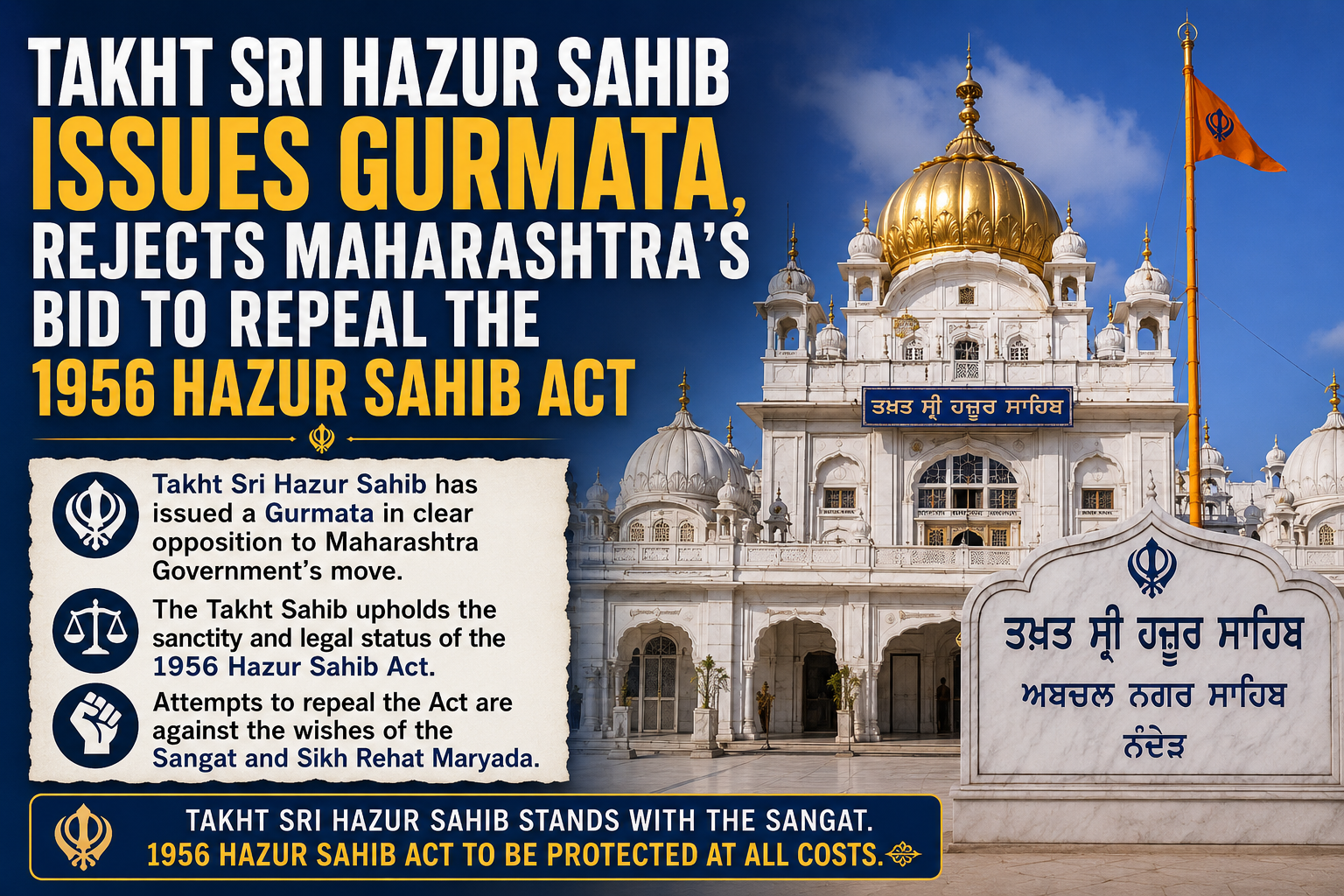
In a forceful assertion of religious self-governance, the custodians of Takht Sri Hazur Sahib in Nanded have issued a gurmata—a collective religious edict pronounced in the name of the Guru—rejecting the Maharashtra government’s plan to scrap the seven-decade-old law that governs the historic shrine. The decision has set the stage for a fresh confrontation between the state administration and the wider Sikh religious establishment over who controls one of Sikhism’s five supreme temporal seats.
What the Gurmata Says
The edict was the outcome of a high-level congregation that brought together the Panj Pyare (the Guru’s five beloved ones), senior clergy and representatives of several Sikh religious bodies. After extended deliberations, those present adopted a unanimous resolution demanding that the original Nanded Sikh Gurdwara Sachkhand Sri Hazur Abchalnagar Sahib Act, 1956 be retained in full and that the government abandon its proposal to replace it.
The gurmata was formally read out by Singh Sahib Giani Ram Singh in the presence of the Takht Jathedar, Giani Kulwant Singh. Because a gurmata is regarded within the Sikh tradition as a binding collective decision taken in the Guru’s name, the pronouncement carries significant moral and institutional weight across the panth.
At its core, the edict argues that the existing administrative structure of Hazur Sahib is rooted in principles laid down by Sikh scholars and shaped by the vision of Guru Gobind Singh, who spent his final days at Nanded. The new legislation, the caretakers contend, risks eroding those foundations and diluting the established traditions and maryada (religious code) of the Takht. One former senior functionary associated with the shrine voiced a widely shared suspicion that the state’s renewed push is driven by vested interests aimed at interfering in the Takht’s internal affairs.
The Maharashtra Government’s Proposal
The trigger for the gurmata was a recent decision by the Maharashtra Cabinet, chaired by Chief Minister Devendra Fadnavis, to approve the repeal of the 1956 Act and bring in a new law titled the “Takht Sachkhand Sri Hazur Abchalnagar Sahib Gurdwara Act.”
The proposed legislation is set to be tabled during the ongoing Vidhan Sabha session. If passed, it would create an entirely new administrative framework for the gurdwara board, including revised provisions covering elections, day-to-day management and by-laws. The government has justified the overhaul by pointing to recommendations from a state-appointed committee, which suggested structural changes to the way the shrine is governed.
A Pattern of Pushback
The current standoff is not an isolated episode but the latest chapter in a recurring tug-of-war over control of the board. The move has provoked sharp reactions across Sikh institutions, with major panthic organisations—including the Shiromani Gurdwara Parbandhak Committee (SGPC) and the Akal Takht—publicly opposing what they describe as repeated attempts by the government to amend the law in order to extend its influence over the shrine. These bodies have framed the proposal as a direct intrusion into the religious autonomy of one of Sikhism’s five Takhts and have cautioned against any effort to tamper with its religious code or administrative independence.
The history bears out their concerns. In February 2024, the Maharashtra government pushed through an amendment allowing it to directly nominate 12 of the 17 members of the gurdwara board. That amendment simultaneously cut down the SGPC’s nomination rights and abolished the representation of the Chief Khalsa Diwan, the Hazuri Sachkhand Diwan and Sikh Members of Parliament. Following large-scale protests led by the SGPC and local Sikh organisations, the government was eventually forced to roll back the changes. Similar attempts in 2018 and 2019 were also resisted and ultimately foiled.
Why It Matters
Takht Sri Hazur Sahib holds a place of immense significance in the Sikh faith as the site where Guru Gobind Singh passed away and where the Guru Granth Sahib was installed as the eternal Guru. For the wider Sikh community, control over the management of such a shrine is not merely an administrative question but one tied directly to religious identity, tradition and autonomy. The repeated friction over the 1956 Act reflects a deeper and unresolved tension between state legislative authority and the principle of self-governance long claimed by Sikh religious institutions.
With the gurmata now formally pronounced and the new bill expected to reach the floor of the Maharashtra Assembly, the coming weeks are likely to see intensified mobilisation by the SGPC, the Akal Takht and allied panthic bodies. Whether the Fadnavis government presses ahead in the face of this unified opposition—or once again retreats as it did in 2024—will determine the next phase of a dispute that has now stretched across nearly a decade.
Source: The Tribune. This article has been written for B2C Buzz based on reporting by GS Paul / Tribune News Service.