July 17, 2026
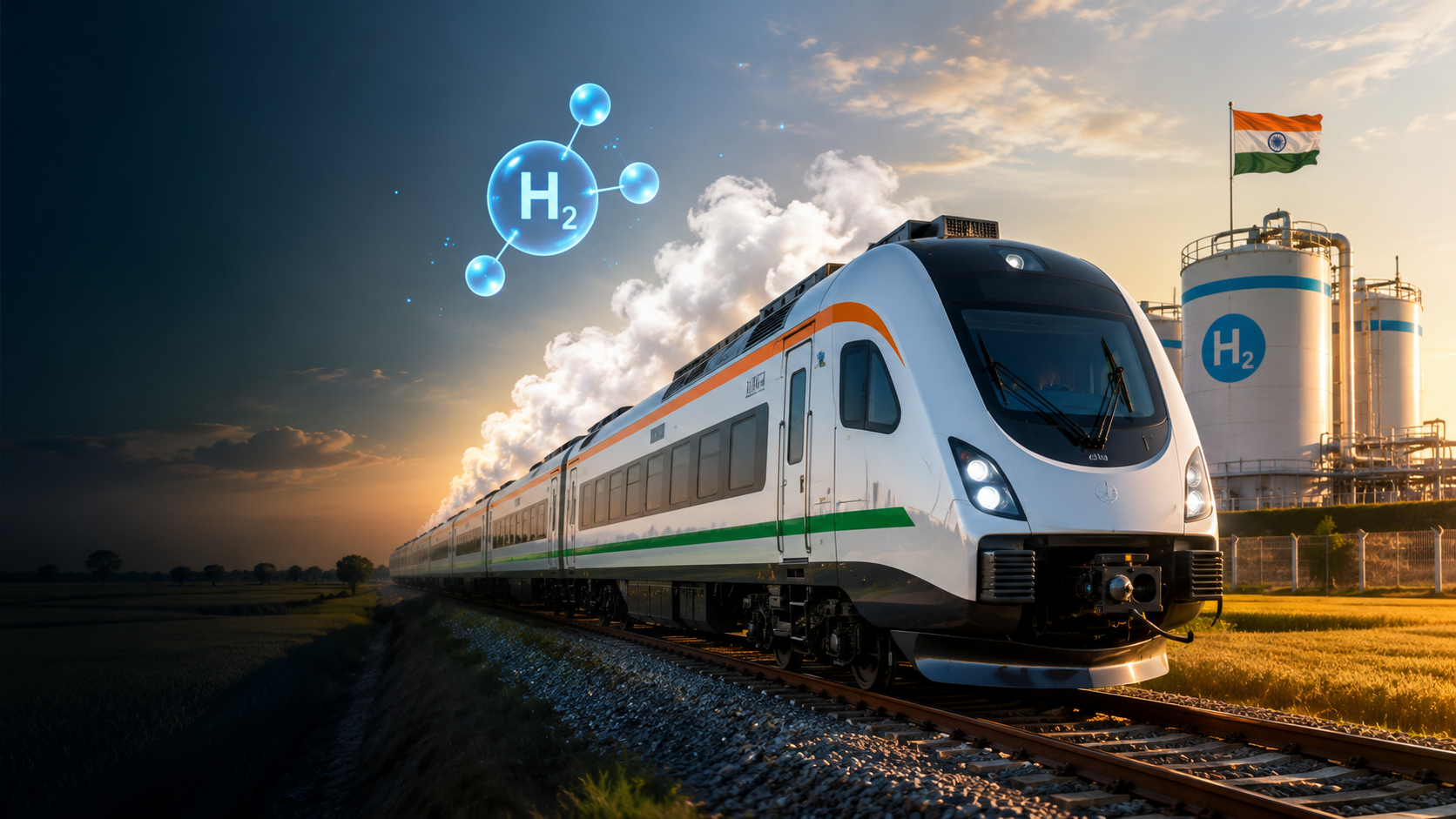
On July 17, 2026, Prime Minister Narendra Modi flagged off India’s first hydrogen-powered train from Jind, Haryana — a moment the Railway Ministry has framed as a landmark in the country’s transition to zero-emission transport. The train will run on the 89-kilometre Jind–Sonipat section of Northern Railway, generating its own electricity onboard from hydrogen fuel cells and emitting nothing but water vapour and heat.
The launch came bundled with a larger political and developmental package: projects worth over ₹14,700 crore for Haryana, including railway and highway infrastructure, two new medical colleges, heritage conservation works, and a Sikh Museum in Kurukshetra. Speaking partly in Haryanvi at a rally at the HUDA ground, the Prime Minister called the hydrogen train a historic milestone, saying Jind, Sonipat, and Haryana had earned a permanent place in India’s railway history, and predicted the hydrogen ecosystem taking shape in Jind would generate employment for local youth.
Beyond the ceremony, the story of this train is more layered — technologically ambitious, economically debatable, and strategically interesting. Here is the full picture.
What Exactly Was Launched
The trainset is a retrofitted Diesel Electric Multiple Unit (DEMU) converted to hydrogen fuel cell propulsion, sanctioned as a pilot project at a cost of ₹111.83 crore including ground infrastructure. Its specifications make it distinctive by global standards:
Length and power. The train runs ten coaches — two Driving Power Cars rated at 1,200 kW each (2,400 kW combined) plus eight passenger coaches. Most hydrogen trains elsewhere, including Germany’s pioneering Coradia iLint, run around five coaches. This makes the Indian trainset the longest and among the most powerful hydrogen trains built anywhere, with capacity for up to 2,500 passengers in metro-style seating with air-conditioning, automatic doors, and public address systems.
Speed. Commercial operations are capped at 75 km/h — a deliberately conservative ceiling for a pilot service on a non-electrified branch line. The trainset reportedly touched higher speeds during trials, and the Research, Design & Standards Organisation (RDSO) completed an oscillation trial in March 2026, running the set at around 70 km/h over 20 km to validate its behaviour. For comparison, Germany’s iLint operates at up to 140 km/h on regional lines. The Indian train’s claim to distinction is scale, not speed.
Fuel supply. A dedicated hydrogen plant at Jind produces green hydrogen through electrolysis, with a storage capacity of 3,000 kg and an assured 11 kV power supply. The plant was established with support from Spanish firm Green H, while the fuel cell systems come from Tata Advanced Systems.
Safety. The train carries a multi-layer safety architecture certified by Germany’s TÜV SÜD and India’s Petroleum and Explosives Safety Organisation (PESO), including hydrogen leak and flame detectors, automatic shut-offs, and continuous high-flow ventilation to dilute any escaping gas.
How Hydrogen Propulsion Works
A hydrogen fuel cell train is essentially an electric train that carries its own power station. Compressed hydrogen stored in onboard tanks is fed into fuel cells, where it reacts with oxygen from ambient air to produce electricity, with water vapour as the only exhaust. That electricity drives traction motors, supplemented by onboard batteries that store surplus fuel-cell output and recovered braking energy, then release it during acceleration.
The appeal is obvious: zero direct emissions, dramatically quieter operation than diesel, and no need for overhead electrification. The trade-off is equally real: converting electricity into hydrogen and back into electricity loses roughly two-thirds of the original energy, compared with the 80-plus per cent efficiency of drawing power directly from overhead wires.
India Is Not First — and the Global Trend Is Sobering
India joins a small club of nations that have run hydrogen trains, and it arrives at an interesting moment in that technology’s story.
Germany pioneered the field. Alstom’s Coradia iLint entered commercial service in 2018 as the world’s first hydrogen fuel-cell passenger train, and in 2022 the state of Lower Saxony inaugurated a full fleet of 14 units replacing diesel on a roughly 100 km network connecting Cuxhaven, Bremerhaven, Bremervörde, and Buxtehude. Alstom ultimately delivered 41 iLint trainsets to two German rail agencies. But by late 2024, Lower Saxony had withdrawn most of its hydrogen fleet from service, and German regional operators have signalled that future orders will favour battery-electric trains instead.
Japan began fare-paying tests of its HYBARI (FV-E991) fuel-cell/battery hybrid on the Tsurumi Line in 2022, but has not scaled the programme.
China’s CRRC-built hydrogen passenger train has run test operations without moving into volume production.
France, home to Alstom, has orders and pilot projects underway but has moved slower than initially planned. Saudi Arabia began trials of the Middle East’s first hydrogen train in 2023.
The recurring pattern is not technological failure — hydrogen trains work. The problem is economics. On most routes, battery-electric trains beat hydrogen on cost and energy efficiency, particularly on runs under roughly 150 km where charging infrastructure at each terminus suffices. The supplier base has also wobbled: Cummins recently exited the fuel cell business after losses of around $657 million, including the unit that supplied stacks for the Coradia iLint.
India is thus entering hydrogen rail just as early adopters are retreating from it — which makes the specific design of India’s programme worth examining closely.
The Government’s Plan: “Hydrogen for Heritage”
India’s hydrogen rail strategy was announced in 2023 under the “Hydrogen for Heritage” programme, with approximately ₹2,800 crore earmarked in the 2023–24 Union Budget for 35 hydrogen fuel cell trains and a further ₹600 crore for hydrogen energy infrastructure. The per-unit economics: an estimated ₹80 crore per train and ₹60–70 crore per route for ground infrastructure covering hydrogen production, storage, and refuelling.
The programme unfolds in two phases:
Phase 1 — the Jind–Sonipat pilot, now operational, exists primarily to generate data. Indian Railways has candidly stated that the running cost of hydrogen trains is not yet established in Indian conditions, and that initial costs will be higher, declining only as fleet numbers grow. The pilot will establish real-world figures for fuel consumption, maintenance, safety protocols, and reliability.
Phase 2 — the 35-train fleet targets India’s eight heritage and hill railways, which currently run on steam or diesel: the Darjeeling Himalayan Railway, Kalka–Shimla Railway, Nilgiri Mountain Railway, Matheran Hill Railway, Kangra Valley Railway, Bilmora–Waghai, Mhow–Patalpani, and Marwar–Devgarh lines. Several of these are UNESCO World Heritage sites on narrow or metre gauge, where stringing overhead electric wire is considered both impractical and environmentally undesirable. Indian Railways has been preparing a tender worth roughly ₹3,000 crore (about $330 million), with firms including BHEL, Hitachi, Siemens, Cummins, Wabtec, and Medha Servo expressing interest at pre-tender consultations.
The route choice is strategically deliberate. Rather than competing with electrification on trunk lines — a contest hydrogen would lose — the programme aims hydrogen at precisely the niche where it retains a case: short, scenic, ecologically sensitive corridors where diesel exhaust is most objectionable and wires are unwelcome.
The Economics: What Hydrogen Actually Saves — and What It Doesn’t
The fuel-saving case for hydrogen trains in India deserves honest scrutiny, because the arithmetic is less flattering than the headlines.
Indian Railways has electrified the overwhelming majority of its broad-gauge network — over 99 per cent by some counts — meaning diesel’s share of traction is already small and shrinking. Hydrogen is not displacing electric traction; it is displacing residual diesel on branch lines and heritage routes.
A single trainset on a mainline branch like Jind–Sonipat, running two to three round trips daily, might displace an estimated 500,000–800,000 litres of diesel annually — worth perhaps ₹4.5–7 crore at current prices. But the 35-fleet’s heritage routes are short, low-frequency lines where annual utilisation per train is far lower. Across the full fleet, total diesel displacement plausibly lands in the range of 5–15 million litres a year — well under one per cent of Indian Railways’ total diesel consumption of roughly two billion litres. (These are estimates constructed from utilisation assumptions; the Railways has published no official savings figure.)
Set against ₹80 crore per train — several times the cost of a conventional DEMU — the fuel savings alone will never repay the capital. The programme’s justification therefore rests on other pillars:
Environmental protection where it matters most. Eliminating diesel and steam exhaust in Himalayan and Nilgiri mountain ecosystems, several of them UNESCO-protected, has value that doesn’t appear in a fuel ledger.
Avoided electrification capex. Overhead wire costs roughly ₹1–1.5 crore per route-kilometre plus lifetime maintenance — spending that never pays back on low-traffic heritage lines.
Industrial policy. The programme creates a captive, high-volume domestic demand base for the National Green Hydrogen Mission, helping justify indigenous electrolyser and fuel-cell manufacturing at a moment when global suppliers are retrenching. Fuel-cell technology developed for rail also has spillover potential into trucks, tugboats, and heavy industry.
Strategic capability. Operational experience in hydrogen storage, handling, safety, and maintenance is a capability India acquires regardless of whether this particular fleet is ever cost-competitive.
Energy security. Every litre of diesel displaced by domestically electrolysed hydrogen is fuel not imported — modest in volume, but aligned with the stated goal of energy independence by 2047 and Net Zero by 2070.
Why the Train Runs at 75 km/h
A common question after the launch: why is India’s newest train slower than trains introduced decades ago? Three reasons, in descending order of importance.
First, the route. Jind–Sonipat is a non-electrified branch line whose track geometry, signalling, and level crossings would cap speeds regardless of what runs on it. Even India’s fastest trainset, the Vande Bharat — capable of 180 km/h — averages only 69–96 km/h in service because the track beneath it hasn’t caught up with the technology above it.
Second, pilot caution. First-of-type trainsets receive conservative speed sanctions until service data accumulates. RDSO validated the set at 70 km/h; 75 km/h sits just above that, and the ceiling will likely rise if the pilot performs well.
Third, and least significant, the propulsion physics. Fuel cells respond slowly to load changes, hydrogen tanks and battery packs add mass, and 2,400 kW spread across ten coaches is modest. But since the five-coach iLint manages 140 km/h on the same basic technology, hydrogen itself is not the binding constraint. The train is slow because of where it runs and because it is new — not primarily because of what fuels it.
The Road Ahead
Whether India’s hydrogen rail bet pays off depends almost entirely on what the Jind–Sonipat pilot reveals over the next one to two years: actual hydrogen consumption per kilometre, fuel-cell durability in Indian heat and dust, refuelling turnaround times, and the real cost per train-kilometre against diesel and battery-electric alternatives.
The programme’s timeline history counsels patience — field trials originally expected in 2023–24 slipped to March 2025 and then to the July 2026 launch. The ₹3,000 crore tender for the 35-train fleet, and its eventual delivery schedule, should be read with that record in mind.
But the strategic logic is coherent in a way that pure fuel economics is not. India has built the world’s longest hydrogen trainset, established green hydrogen production and certification pipelines, engaged domestic manufacturers in fuel-cell systems, and targeted the one class of route where hydrogen’s case survives contact with battery-electric competition. If the global hydrogen rail story has so far been one of impressive technology meeting unforgiving economics, India’s version is at least asking a different question: not whether hydrogen can beat electrification everywhere, but whether it can serve the specific corridors where nothing else fits — while pulling a domestic hydrogen industry into existence along the way.
The whistle at Jind on July 17 was, in that sense, less the end of a journey than the start of an experiment. The data will decide the rest.
Sources
- ANI News — “‘Tevar’ of Jind has transformed: PM Modi launches nation’s first hydrogen train in Haryana” (July 17, 2026) https://aninews.in/news/national/general-news/tevar-of-jind-has-transformed-pm-modi-launches-nations-first-hydrogen-train-in-haryana20260717141503/
- Organiser — “Jind’s Tevar has changed: PM Modi launches India’s first hydrogen train, rolls out Rs 14,700 crore projects” (July 17, 2026) https://organiser.org/2026/07/17/370340/bharat/jinds-tevar-has-changed-pm-modi-launches-indias-first-hydrogen-train-rolls-out-rs-14700-crore-projects/
- NewKerala — “PM Modi flags off India’s first hydrogen train” (July 17, 2026) https://www.newkerala.com/news/a/pm-modi-flags-off-indias-first-hydrogen-train-877.htm
- Al Jazeera — “India debuts hydrogen-powered train as part of sustainability drive” (July 17, 2026) https://www.aljazeera.com/economy/2026/7/17/india-debuts-hydrogen-powered-train-as-part-of-sustainability-drive
- The Tribune — “India’s first hydrogen-powered train set for flag-off: Here’s how it works” (July 16, 2026) https://www.tribuneindia.com/news/explainers/indias-first-hydrogen-powered-train-set-for-flag-off-heres-how-it-works/
- Press Information Bureau (Govt of India) — “Indian Railways to run 35 Hydrogen trains under ‘Hydrogen for Heritage'” (February 2023) https://www.pib.gov.in/PressReleasePage.aspx?PRID=1896102
- DD News — “Charting a Green Course: Hydrogen-Fuelled Trains in India” https://ddnews.gov.in/en/charting-a-green-course-hydrogen-fuelled-trains-in-india/
- Vision IAS Current Affairs — “India set to launch its First Hydrogen Train under ‘Hydrogen for Heritage’ Project” (July 13, 2026) https://visionias.in/current-affairs/news-today/2026-07-13/science-and-technology/india-set-to-launch-its-first-hydrogen-train-under-hydrogen-for-heritage-project
- NEXT IAS — “Hydrogen Trains in India: Green Transition or Experiment?” (July 17, 2026) https://www.nextias.com/ca/editorial-analysis/17-07-2026/hydrogen-trains-india
- Deccan Herald — “India’s first hydrogen-powered train to be launched in Haryana” (January 6, 2026) https://www.deccanherald.com/amp/story/india%2Fharyana%2Findias-first-hydrogen-powered-train-to-be-launched-in-haryana-3853055
- Deccan Herald — “Indian Railways may invite tender for hydrogen trains” (February 27, 2023) https://www.deccanherald.com/national/indian-railways-may-invite-tender-for-hydrogen-trains-1195447.html
- Alstom — “Coradia iLint – the world’s 1st hydrogen powered passenger train” https://www.alstom.com/solutions/rolling-stock/alstom-coradia-ilint-worlds-1st-hydrogen-powered-passenger-train
- Al Jazeera — “Germany inaugurates world’s first hydrogen-powered train fleet” (August 24, 2022) https://www.aljazeera.com/news/2022/8/24/germany-inaugurates-worlds-first-hydrogen-powered-train-fleet
- Railway Age — “Hydrogen Power Has Arrived” (November 5, 2025) https://www.railwayage.com/passenger/hydrogen-power-has-arrived/
- Autonocion — “Germany Is Pulling Its Hydrogen Trains. Japan Never Scaled Its Own. India Just Built the World’s Longest One” (May 29, 2026) https://www.autonocion.com/us/hydrogen-train-uk-india-germany/
- The Energy Consortium (IIT Madras) — “Hydrogen Trains: India’s Next Leap Toward Sustainable Railways” (December 2024) https://energyconsortium.org/hydrogen-trains-indias-next-leap-toward-sustainable-railways/
- US International Trade Administration — “India Railways Market Intelligence” https://www.trade.gov/market-intelligence/india-railways
- Gulf News — “India tests first hydrogen-powered train coach” https://gulfnews.com/world/asia/india/india-tests-first-hydrogen-powered-train-coach-1.500210889
Note: Estimates of diesel displacement and fuel-cost savings in this article are analytical constructions based on stated assumptions about route utilisation and consumption rates; Indian Railways has not published official savings figures. The Railways has stated that hydrogen train running costs are not yet established in Indian conditions.