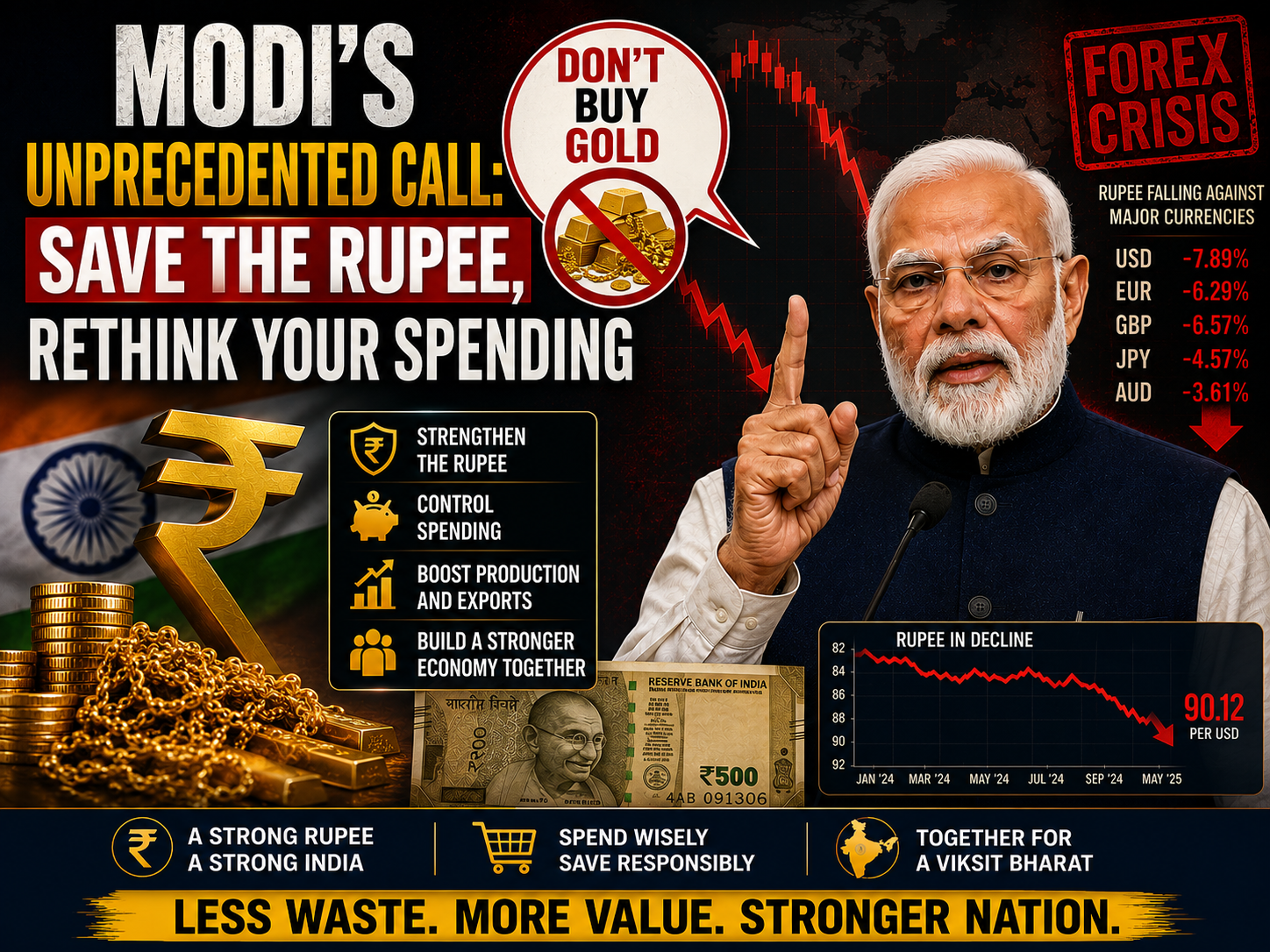
As crude oil crosses $120 per barrel and West Asia burns, Prime Minister Modi has made a rare direct appeal to 1.4 billion Indians — spend less abroad, skip the gold, and embrace austerity as a form of patriotism. What does it actually mean for how Indians spend their money overseas?
Economy Desk · Analysis & Commentary · May 11, 2026 · 8 min read
In an extraordinary address to the nation in Hyderabad on May 10, 2026, Prime Minister Narendra Modi did something no Indian prime minister has done in recent memory: he asked ordinary citizens to voluntarily restrain their personal spending — not because of a domestic recession, but because of a geopolitical storm halfway across the globe.
The occasion was a public gathering, but the message was unmistakably national. India’s foreign exchange reserves are under pressure. The war in West Asia has sent crude oil prices soaring above $120 per barrel. Every litre of petrol, every gram of gold, every holiday abroad, every bottle of imported cooking oil — all of it drains dollars from India’s reserves. And Modi wants Indians to help plug that drain.
“Petrol-diesel has become so expensive across the world. It is the responsibility of all of us that the foreign exchange spent on purchasing petrol-diesel should also be saved by conserving petrol-diesel,” the Prime Minister said.
What Modi Actually Said — and What He Didn’t
Before interpreting the Prime Minister’s words, it is important to be precise about what he actually appealed for. This was not a government policy announcement. No new law was passed. No tax was levied. No regulation was changed. This was a voluntary public appeal — a call to patriotic restraint — framed explicitly as a citizen’s duty in a time of global crisis.
His five specific asks were:
Gold: Avoid buying gold for weddings and functions for at least one year. India imports 700–800 tonnes of gold annually, representing a massive drain on foreign exchange. “There was a time during trouble or wars, people would donate gold to the government,” Modi said. “But now, there is no need for such donations — but in the interest of the country, we must decide that we will not buy gold for one year. Our Desh Bhakti is challenging us on this front.”
Foreign Travel: Postpone international holidays and destination weddings for at least one year. “For at least one year, we should resolve to postpone foreign visits. India has many places that we can visit, hold weddings. We have to take every possible step to conserve foreign exchange,” he said.
Fuel Conservation: Use public transport, metro systems, and carpooling. Consider electric vehicles. Reduce petrol and diesel consumption through deliberate behavioural change.
Work From Home: Revive WFH practices from the Covid era wherever possible, to reduce daily commuting and fuel consumption. “During the Corona period, we adopted work from home, online meetings, video conferences,” he said. “Today, the need of the hour is that we restart those practices.”
Imported Foods and Fertilisers: Cut usage of imported edible oils and chemical fertilisers. Shift toward natural farming and locally produced alternatives, even if only a 10–15% reduction can be achieved.
Crucially, Modi made no mention of overseas real estate investment, NRI remittances, foreign stock market investments, or business travel. His appeal was directed squarely at discretionary consumer spending — the kind that drains forex without producing long-term economic returns for India.
Why Now? The Economics Behind the Appeal
India is structurally dependent on imports for several of its most essential needs. Crude oil tops the list, followed by gold, edible oils, fertilisers, and electronic components. In normal times, India manages this through export earnings and foreign investment inflows. But the West Asia war has disrupted this balance sharply.
Oil marketing companies are reportedly facing monthly under-recoveries of nearly ₹30,000 crore collectively. India’s import bill has risen by billions of dollars over the past quarter alone. Forex reserves, while not yet in crisis territory, are facing periodic pressure that the government clearly wants to prevent from deepening.
The appeal to avoid gold purchases is particularly pointed. Gold is India’s second-largest import by value after crude oil. Unlike petroleum, gold serves no industrial purpose in most household purchases — it is bought for weddings, as investment, and for cultural gifting. Every tonne of gold imported sends foreign exchange out of India and into international bullion markets. With reserves under strain, even a partial reduction in gold imports would meaningfully ease the pressure.
India imports roughly 700–800 tonnes of gold every year. It imports around 60% of its edible oil requirements. These are not small numbers. And in a world where crude is trading above $120 a barrel, the cumulative cost of these dependencies becomes acute very quickly.
The Patriotic Framing — and Its Limits
Modi’s framing of this appeal is notable. He invoked “Desh Bhakti” — patriotism — explicitly. He drew a comparison to wartime gold donations, when Indians voluntarily surrendered their jewellery to fund national defence. He is not asking for that level of sacrifice. He is asking for something more modest: a temporary pause on discretionary luxury spending.
The framing, however, has limits. Voluntary appeals have a mixed track record. Indians buy gold for deeply cultural reasons — weddings, religious ceremonies, family traditions — that are not easily overridden by government messaging. The gold jewellery industry employs millions of artisans, traders, and retailers. A sustained drop in gold buying, even if patriotically motivated, would ripple through that ecosystem in ways Modi’s appeal did not address.
Similarly, the tourism industry — hotels, airlines, travel agents — could face short-term pain if the foreign holiday appeal gains meaningful traction. The government’s ask is to redirect that spending toward domestic tourism, which would offset some of the demand, but the economics are not equivalent.
It is also worth noting that India has faced forex crises before — most famously in 1991, when the country had to pledge gold reserves to the IMF and impose emergency import controls. The current situation is not comparable in severity, but the government appears determined to act early and prevent a deeper crisis through demand-side management rather than waiting for reserves to fall further.
What This Means for Indian Overseas Spending
For the average urban Indian, Modi’s appeal translates into a specific set of behavioural nudges. Skip the Bangkok honeymoon, consider Goa instead. Hold off on buying that gold set for your sister’s wedding. Take the metro to work. Order less palm oil-based processed food.
These are not enormous sacrifices for any single household. But India has 1.4 billion people. Even a modest shift across a significant fraction of the population would produce measurable macroeconomic effects. A 10% reduction in gold imports alone would save several billion dollars in annual forex outflow.
For NRIs — Indians living abroad — the appeal is more nuanced. Modi’s ask was directed at residents spending foreign exchange, not at NRIs earning foreign currency and remitting it home. In fact, NRI remittances are a positive contributor to India’s forex position. The government’s framing implicitly exempts that category of overseas financial activity entirely.
What the appeal does not cover is equally important to note. It says nothing about overseas real estate investment, foreign stock market activity, business travel, medical tourism abroad, or NRI remittances. Anyone reading Modi’s speech as a broad instruction to stop all overseas financial activity would be misreading it significantly.
Will It Work?
The honest answer is: partially, and only in the short term.
Voluntary appeals can shift behaviour at the margins, especially when framed around national duty and backed by a leader with significant public trust. Modi’s political capital remains considerable, and his messaging machine is effective at amplifying such calls.
But structural import dependency does not change because of a public speech. India will still need crude oil. Weddings will still happen, and many families will still buy gold regardless of government appeals. The real test is whether this voluntary phase is followed by structural reforms — faster EV adoption, diversified oil import sources, support for domestic edible oil production, deeper gold monetisation schemes that channel existing household gold into the financial system rather than relying on perpetual new imports.
The appeal is, at its core, a signal — to citizens, to markets, and to India’s trading partners — that the government is aware of the forex pressure and is willing to mobilise public sentiment to address it. Whether that signal translates into meaningful macroeconomic relief depends on factors far beyond any prime minister’s speech: the duration of the West Asia conflict, global oil market dynamics, and whether a ceasefire brings prices back down before India’s reserves feel serious strain.
What is certain is that this moment marks a rare intersection of geopolitics and household economics in India. The wars of West Asia have, for the first time in years, made their way into how ordinary Indians are being asked to think about buying gold, booking holidays, and driving to work. Whether they listen — and for how long — will shape, in a small but real way, India’s economic resilience through the months ahead.