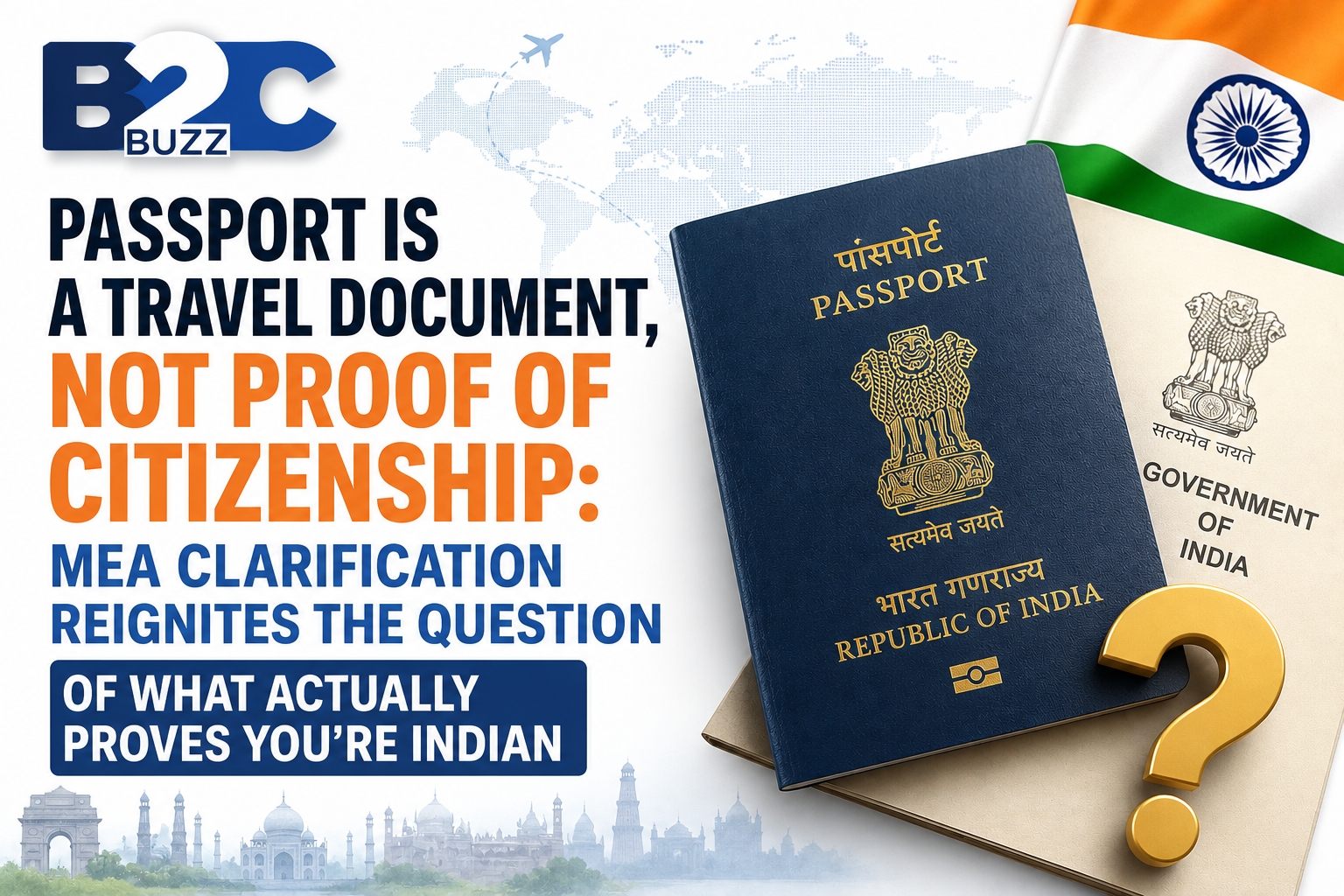
A clarification from a senior Ministry of External Affairs (MEA) official has set off a fresh round of public debate over one of the more confounding gaps in Indian administrative law: if a passport — issued only to citizens — isn’t proof of citizenship, then what is?
What the MEA actually said
Speaking on the occasion of the 14th Passport Seva Divas, a senior MEA official clarified that an Indian passport is fundamentally a travel document and “not a document of citizenship.” The official explained that while passports attest to the nationality of Indians when they travel abroad, they remain travel documents at their core. The WireThe Wire
The remark was made on condition of anonymity and came in response to a pointed question: could a person left out of the Election Commission’s electoral roll revision fall back on their passport to establish citizenship? The official’s answer effectively was no — though it was stressed that passports are issued only after “a lot of due diligence,” once authorities are satisfied that the applicant is entitled to one. The Wire
The clarification carried a subtle but important nuance. Although passports are issued exclusively to Indian citizens, the government noted that the document itself remains the property of the Government of India — and possession of it does not, by itself, conclusively settle one’s citizenship status. India Today NE
The legal grey zone
The reason this lands awkwardly is that Indian law doesn’t offer a clean answer. Under Section 6(2)(a) of the Passports Act, 1967, passport authorities must refuse to issue a passport if the applicant is not a citizen of India. On its face, that seems to tie a passport tightly to citizenship. The Wire
Yet the picture gets muddier. The government’s own Passport Manual describes a passport as an identity and travel document that “provides evidence of the holder’s nationality,” while also noting that the Union government may issue passports or travel documents to non-nationals in specified circumstances under Section 20 of the Act. So a document that evidences nationality can, in certain cases, also go to people who aren’t nationals — which is precisely why it can’t function as airtight proof. The Wire
The courts haven’t drawn a single clear line either. There has been no definitive judicial order on the matter, and courts have approached it differently depending on context. In a 2018 case, the Delhi High Court treated the grant of an Indian passport as a significant factor in examining a citizenship dispute, describing a passport as a document evidencing nationality. More recently, however, the Bombay High Court observed that questions of citizenship must ultimately be examined under the Citizenship Act, 1955, and cannot be resolved solely by reference to identity documents such as Aadhaar, PAN or voter ID. The Wire + 2
Why this is surfacing now: the electoral roll revision
The timing is no accident. The clarification arrives in the middle of the Election Commission’s Special Intensive Revision (SIR) of electoral rolls, an exercise that has thrown the whole question of citizenship documentation into sharp relief.
During Supreme Court hearings on petitions challenging the Bihar SIR, the Election Commission argued that Aadhaar establishes identity but not citizenship, since it can be issued to residents who aren’t Indian citizens. A bench of Justices Surya Kant and Joymalya Bagchi, in an August 2025 ruling, held that the use of Aadhaar while filing claims and objections would strictly be treated as proof of identity and not as evidence of Indian citizenship. While upholding the SIR, the Court directed the Commission to accept Aadhaar as an additional document for identity verification, but not as proof of citizenship. The Wire + 2
Passports were among the documents accepted for the SIR exercise in Bihar and elsewhere, which is exactly why the MEA’s reframing of the passport’s status struck a nerve.
The unanswered question: what does prove citizenship?
This is where the public frustration crystallises. Strip away Aadhaar, voter ID, PAN and now the passport, and Indians are left without an obvious, universal document that conclusively establishes nationality.
The reason is structural. According to the Ministry of Home Affairs, Indian citizenship is determined under the Citizenship Act, 1955, which lays out five routes to nationality — birth, descent, registration, naturalisation, or territorial merger. Unlike some countries, India has never created anything resembling a “National Citizenship Card,” and most Indians — citizens by birth — therefore hold no separate citizenship certificate at all. The Daily JagranThe Daily Jagran
The commonly held documents each fall short of the mark: Voter ID proves registration on the electoral roll, PAN is a tax identifier, the ration card is a welfare document, and the passport is a travel document — none of them conclusive proof of citizenship. The Daily Jagran
Government messaging hasn’t closed the gap. A 2019 Press Information Bureau document on the National Register of Citizens stated that citizenship could be proved by submitting documents related to date and place of birth, but added that a decision on which documents would be acceptable was yet to be taken. As of June 2026, the Ministry of Home Affairs has still not finalised a definitive nationwide list of acceptable documents to prove Indian citizenship. For context, citizenship by birth itself depends on when a person was born: those born in India between 26 January 1950 and 1 July 1987 are citizens by birth; those born between 1 July 1987 and 2 December 2004 require at least one Indian-citizen parent; and those born on or after 3 December 2004 qualify only if both parents are citizens, or one is a citizen and the other is not an illegal immigrant at the time of birth. Outlook India + 2
The backdrop: a passport system being celebrated even as its limits are spelled out
There’s an irony in the messaging. The clarification came on a day meant to showcase the strength of India’s passport machinery. The MEA said it delivered around 1.5 crore passports and related services in 2025, including 1.39 crore passports, and that roughly 1.47 crore chip-enabled passports have been issued since their rollout last year. Average processing times have been cut to five to six working days, excluding police verification. The service network has expanded to 545 Passport Seva Kendras and related centres, up from just 77 a decade ago, with citizens now spending under 45 minutes on average at a centre. The Wire + 2
So on the same platform where the government touted a faster, more accessible passport regime, it also clarified that the document at the heart of it doesn’t do the one thing many citizens assumed it did.
The public reaction
That contradiction is essentially what drove the online backlash. The clarification triggered intense debate on X, with users questioning the legal validity of Aadhaar, voter IDs and passports alike. One user captured the frustration bluntly, asking how the very ministry that issues passports so Indians can prove their citizenship abroad could now say the document isn’t proof of citizenship at home. Outlook IndiaOutlook India
The bottom line
The MEA hasn’t changed the law — it has restated a distinction that has existed all along between documents that establish identity and documents that establish citizenship. A passport sits in an in-between space: issued only to citizens, evidence of nationality abroad, but not, on its own, a conclusive citizenship document at home.
What the episode really exposes is the absence at the centre of it all. India has no single, universal citizenship document, and the government has yet to publish a settled list of what would count as one. Until that gap is filled, clarifications like this one will keep landing on a public that is, understandably, left asking the same question: if not this, then what?