India Hosts the 18th BRICS Summit 2026: A Defining Moment for the Global South
India Hosts the 18th BRICS Summit 2026: A Defining Moment for the Global South
Introduction
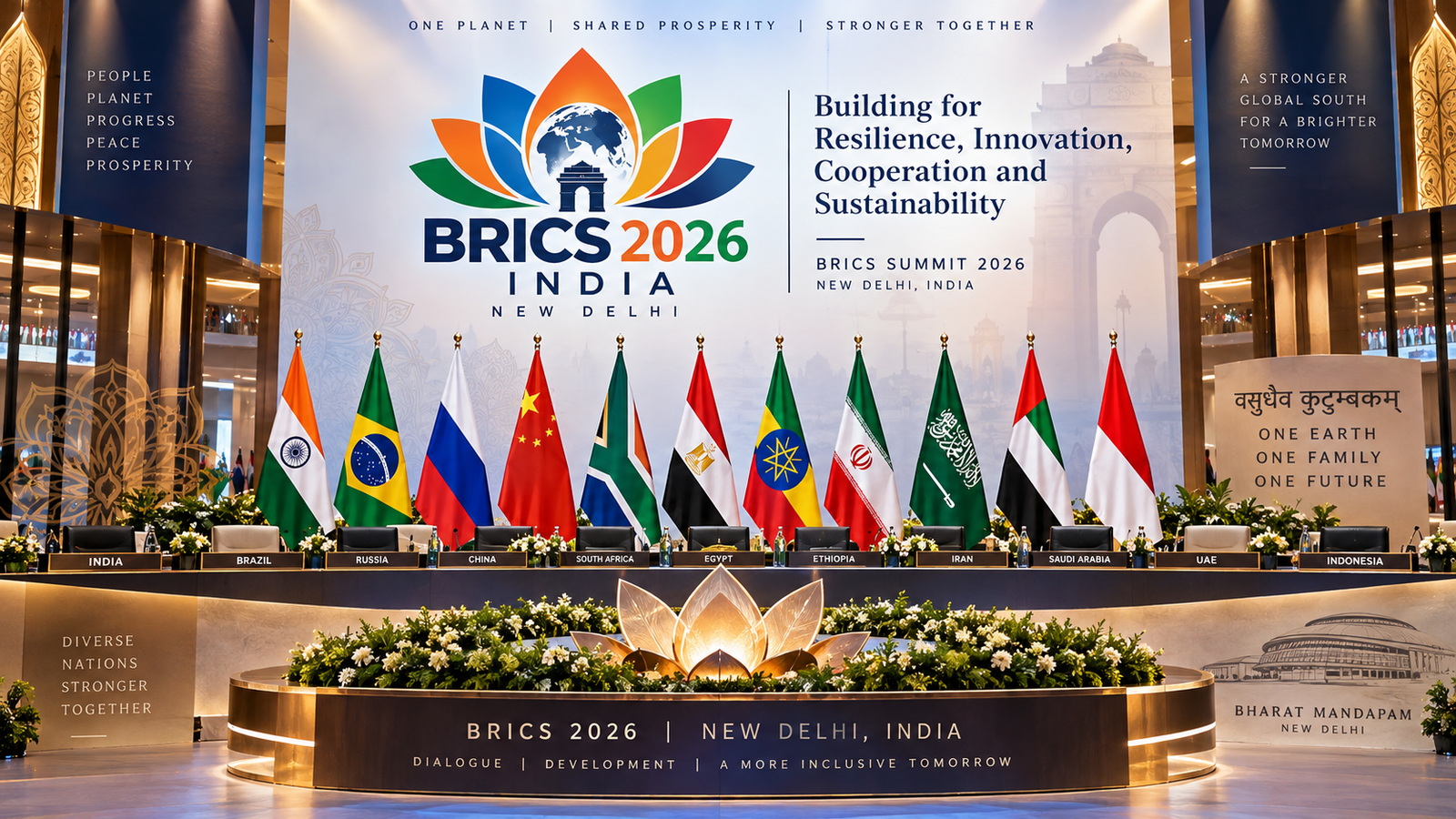
India is hosting the 18th BRICS Leaders' Summit at Bharat Mandapam in New Delhi on 12–13 September 2026, bringing the curtain down on a year-long chairship that has spanned more than 350 meetings and high-level engagements across 25 Indian cities. India assumed the BRICS chairship on 1 January 2026 — its fourth time leading the grouping, following stints in 2012, 2016 and 2021. The summit carries special significance as 2026 marks the 20th anniversary of BRICS, which began as an informal BRIC grouping at a foreign ministers' meeting on the sidelines of the UN General Assembly in 2006.
The Bloc Today
BRICS has transformed dramatically since its early years. What started as Brazil, Russia, India and China — later joined by South Africa in 2011 — has expanded into an 11-member bloc. Egypt, Ethiopia, Iran, Saudi Arabia and the UAE became full members in January 2024, followed by Indonesia in January 2025. Together, the grouping now represents roughly 49 percent of the world's population and around 40 percent of global GDP, giving it substantial economic and diplomatic weight.
Theme and Guiding Vision
India's chairship is anchored in the theme "Building for Resilience, Innovation, Cooperation and Sustainability," rooted in a people-centric approach guided by the principle of "Humanity First." The framing signals India's intent to keep BRICS focused on practical, development-oriented cooperation rather than letting it drift into a purely geopolitical platform.
Who's Attending
The summit gathers leaders of BRICS members, partner countries, outreach invitees and heads of international organisations. Expected attendees include Chinese President Xi Jinping — reportedly visiting India for the first time in seven years — Russian President Vladimir Putin, Iranian President Masoud Pezeshkian, South African President Cyril Ramaphosa, Indonesian President Prabowo Subianto, Egyptian President Abdel Fattah el-Sisi and Ethiopian Prime Minister Abiy Ahmed. Prime Minister Modi is also scheduled to hold high-level bilateral meetings, including with President Putin. UN Secretary-General António Guterres is expected to take part.
Summit Schedule
The summit opens on 12 September with a closed-door leaders' session on "Inclusive Global Governance and Strengthening Multilateralism." The second day features a wider open session titled "Resilience, Innovation, Cooperation and Sustainability: Shaping the Future for Inclusive Global Growth," an official group photograph, and a gala dinner alongside cultural and tree-planting events. The summit concludes on 13 September with the release of the New Delhi Declaration, the document expected to capture the key outcomes and commitments.
The Core Agenda
India has centred its agenda on tangible economic and developmental priorities:
Trade and supply chains — Boosting intra-BRICS trade and investment, securing critical supply chains, and strengthening connectivity. Two key proposals are the BRICS Logistics Supply-Chain Cooperation Framework and the BRICS Global Value Chains Action Plan 2026–2030, aimed at improving trade connectivity and manufacturing integration.
Finance and payments — Expanding cross-border payment systems and promoting greater use of local currencies in trade. India has pushed for these reforms while stopping short of backing a common BRICS currency or a move to replace the dollar-based financial system.
Development financing — A larger role for the New Development Bank in infrastructure and sustainable development, including local-currency financing, plus a proposed BRICS Multilateral Guarantees initiative to reduce investment risk and mobilise private capital.
Technology and innovation — Startups, high-technology cooperation, AI governance and digital tools.
Human capital — Initiatives like BRICS CONNECT for labour-market intelligence and skilling, a BRICS Youth Cooperation Framework 2026, women's digital capacity programmes, and academic exchanges.
Security and health — Food and energy security, disaster preparedness, healthcare (including a BRICS Roadmap on Healthy Lifestyle Promotion 2026–2029), and counter-terrorism.
Global governance reform — Greater representation for developing economies in institutions like the UN Security Council, IMF and World Bank.
The Benefits — In Detail
For India
Elevated global leadership. Hosting positions India at the heart of Global South diplomacy and reinforces its image as a bridge between emerging economies and established powers. Uniquely, BRICS lets India work closely with China, Russia, Gulf states and Brazil while maintaining strong ties with the US and Europe — a balancing act that enhances its strategic autonomy.
Economic and trade gains. By championing balanced intra-BRICS trade, services trade and resilient value chains, India opens new markets for its goods, services and manufacturing base, while attracting investment through mechanisms like the New Development Bank.
Financial flexibility. Easier cross-border payments and greater use of the rupee and other local currencies can reduce transaction costs and dollar dependence for Indian businesses trading within the bloc.
Voice in global reform. The platform amplifies India's long-standing demand for a fairer, more representative international order — including a permanent UN Security Council seat.
Soft power and prestige. Showcasing India's culture, economy and organisational capability to a global audience strengthens its standing as a capable rising power.
For the Bloc and the Global South
A more multipolar order. Collectively, the summit advances alternatives in trade settlement, development finance and governance that give developing nations a stronger collective voice.
Practical cooperation. Frameworks on supply chains, health, skilling and youth translate high-level ambition into on-the-ground benefits potentially reaching billions across the developing world.
Development financing at scale. An expanded New Development Bank and the Multilateral Guarantees initiative can channel capital into infrastructure and sustainable projects across member and partner nations.
Challenges to Watch
India faces a delicate balancing act. The ongoing West Asia conflict has exposed divisions within the enlarged membership — particularly among Iran, the UAE and Saudi Arabia. Similar differences prevented a joint communique after the foreign ministers' meeting earlier in 2026, when India issued a chair's statement instead. Negotiators have been working to find declaration language acceptable to all sides. The New Delhi Declaration will therefore be a key test of whether the expanded bloc can maintain consensus on hard geopolitical issues while delivering on economic cooperation.
Conclusion
The 18th BRICS Summit represents both a milestone and a stress test. On its 20th anniversary, the grouping is larger and more influential than ever — but also more diverse and harder to align. India's chairship, with its practical, "Humanity First" agenda, aims to prove that BRICS can deliver meaningful outcomes for its members and for the wider Global South. Success in New Delhi would cement India's role as a leading voice for emerging economies and reaffirm BRICS as a constructive pillar of a multipolar world.